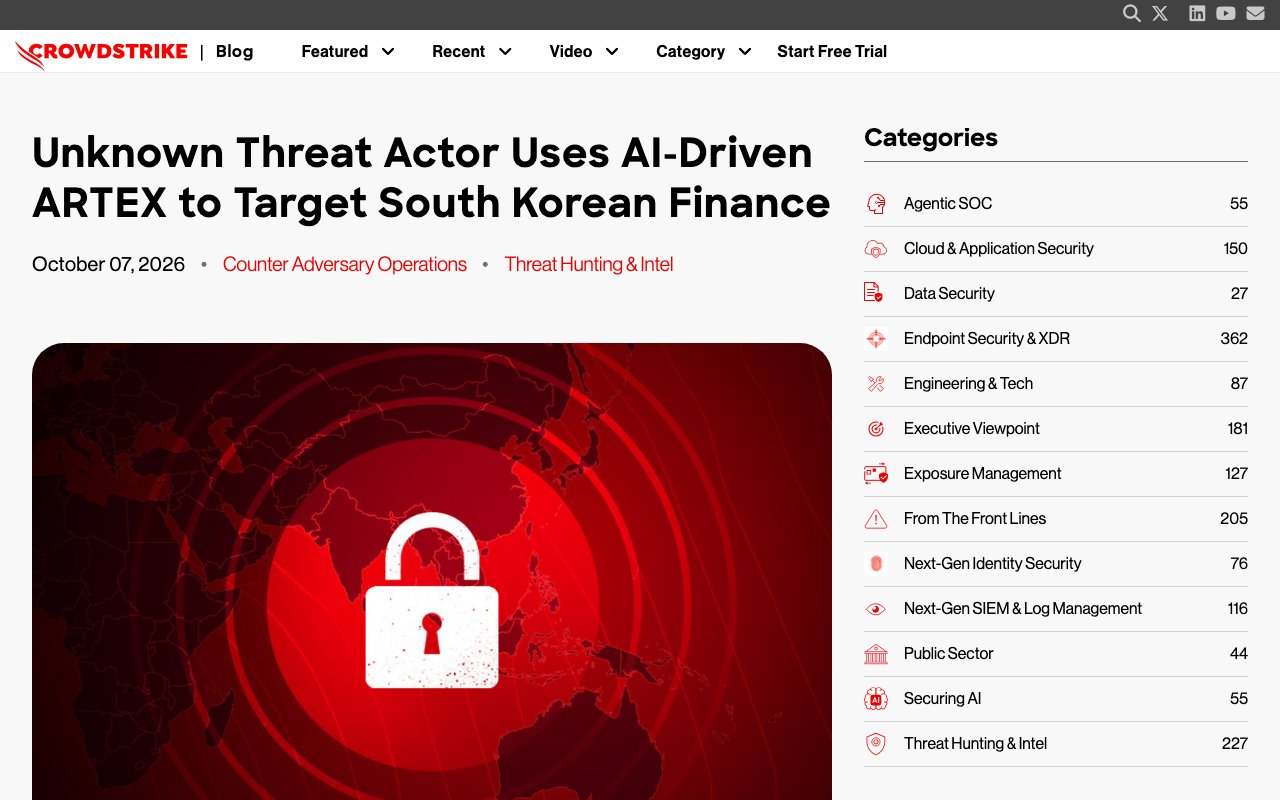
Screenshots show the official pages on the capture date and may differ from the pages at publication. Select an image to enlarge it.
Ask an AI to "find the weak points in this system," and it handles everything from reconnaissance to planning the attack steps on its own. A tool like that has now been reported in use in a real crime. From late September to October 2026, banks and other financial institutions in South Korea were breached one after another and customers' personal data was leaked. The tool the attacker is said to have used is a Chinese AI tool called ARTEX. Based on primary reports from security companies and on Korean, Japanese and English-language coverage, this guide explains what ARTEX is, what happened in the incident and what we should watch out for, as of October 20, 2026.
What ARTEX is
ARTEX is an open-source AI penetration testing tool (meaning its program, the equivalent of a blueprint, can be viewed and used by anyone) that a Chinese developer published on GitHub under the account "Autumn-27." According to South Korea's Korea JoongAng Daily, it was released in July 2026.
A penetration test is work that a company commissions to see whether its own systems can be broken into using the same methods as real attackers, in order to find weak points. It is meant for defenders, and specialists normally carry it out by hand over a long period. ARTEX is a tool that lets you hand this work to AI.
According to the description in Korean reports, ARTEX combines an LLM (large language model) with multiple AI agents and automates tasks like the following, which specialists previously carried out by hand, stage by stage.
- Analyzing the target system
- Analyzing weak points (vulnerabilities)
- Planning the intrusion path, meaning where to get in
- Running security tools and commands
An AI agent is an AI that receives instructions, works out the steps on its own and carries out the work using tools. See "What are AI agents?" for details. ARTEX itself has no AI model; it works by connecting to external AI models through APIs (interfaces that programs call).
The US security company CrowdStrike describes ARTEX as "a recently released open-source agentic penetration testing tool developed in China."
What happened in the attacks on South Korean financial institutions
How far the damage spread
The first breach to come to light was at Shinhan Bank, one of South Korea's major banks. The bank discovered the leak on September 30, 2026, reported it to the authorities and made it public on October 1. The target was a service that loan brokers (loan solicitors) use to check the status of customers' loan applications and similar information. According to Korean newspapers, data on about 25,000 people was leaked, and some records (66) also included resident registration numbers (the equivalent of Japan's My Number).
Breaches at KB Kookmin Bank (119 people), Hana Bank (89 people), Busan Bank and savings banks (financial institutions similar to Japan's shinkin banks) followed one after another. At Yegaram Savings Bank, data on about 40,000 people is estimated to have been leaked. At KB Kookmin Bank, a work support system that employees use on their smartphones was reportedly targeted.
South Korea's Financial Services Commission (the counterpart of Japan's Financial Services Agency) announced that as of October 14, a total of 16 firms had been affected, with about 100,000 records leaked. Besides banks, these include savings banks, lending companies and crypto asset (cryptocurrency) exchanges. The leaked data included names, contact details, resident registration numbers and email addresses. The Financial Services Commission said it had not confirmed any leak of information such as card numbers that could lead directly to fraudulent payments.
Reports also often cite the figure "7 firms and 68,000 people." That was a headcount for 7 firms as of early October, and it differs in both timing and counting method from the "16 firms and about 100,000 records" that the later investigation found.
How the attack unfolded
According to an analysis by the US security company Recorded Future, the attacker was testing the servers used for the attack and scanning the entire internet from August 17 to 22, 2026.
According to points raised during the South Korean National Assembly's parliamentary audit, the first intrusion into KB Kookmin Bank came shortly after 11 p.m. on September 27. At the time, the bank judged it to be "common abnormal traffic" and only blocked the attacking IP address (an address on the internet). In the early hours of September 29, it suffered a second attack from a different IP address, and more data was leaked.
The targets were web pages and servers meant to be used from outside the bank, such as those for loan brokers and employees. The chairman of the Financial Services Commission has also pointed to a tendency for such systems to be targeted. The attacker apparently used automated scanning to find, one after another, places that tend to be less well defended than the main customer-facing systems.
How ARTEX and AI were used
CrowdStrike's report
The detailed report on ARTEX's involvement is the analysis CrowdStrike published on October 7, 2026. CrowdStrike found a folder (an open directory) on a server controlled by the attacker that anyone could look into. Along with ARTEX configuration files, it contained work history and note files from Anthropic's AI coding tool "Claude Code."
According to CrowdStrike, the attacker's ARTEX was configured to connect to the following AI models.
- DeepSeek v4.1-flash (a model from China's DeepSeek; the one mainly used)
- GLM-5.3 (a model from China's Zhipu AI)
- Grok 4.6 (a model from SpaceXSI (formerly xAI))
CrowdStrike says the connection to DeepSeek went through a service that appears to be a reseller of AI API access.
How Claude Code was used
The Claude Code history showed that the attacker had instructed Claude in Chinese on how to carry out the penetration test, and had also asked it to find Telegram (messaging app) groups that buy and sell leaked Korean data. In other words, the attacker consulted AI even on where to sell the stolen information.
Meanwhile, Recorded Future, while stating that the attacker used Claude Code, DeepSeek, Grok and Zhipu AI, wrote that "the available evidence does not show how much AI sped up this attack."
As of October 20, we could not confirm that Anthropic itself has issued any official statement on the incident. Reuters reported that Anthropic did not respond to a request for comment.
The South Korean authorities' view
It is worth noting that official documents from the South Korean authorities do not confirm that ARTEX was used. The Financial Services Commission's announcement only uses the phrase "new risks such as the threat of AI-driven hacking," and does not mention ARTEX by name. According to Reuters, the Financial Services Commission explained that it is "examining the hacking methods in detail to determine whether AI was involved."
The name ARTEX first appeared in an exclusive report by the Korean newspaper Herald Economy on October 2. An official at South Korea's Financial Security Institute (the financial industry's security body) told the paper that "when we traced Shinhan Bank's logs and the attacker's IP addresses, traces of ARTEX use turned up." The official also suggested that it was not AI attacking on its own judgment, but a human hacker using an AI tool.
In short, the information that ARTEX was used comes from analyses by private security companies such as CrowdStrike and Recorded Future, and from remarks by an official.
Who the attacker is
CrowdStrike has not linked the attacker to any known attack group. Because the Chinese-made ARTEX and Chinese-language instructions were used, it assesses the attacker as "likely Chinese-speaking and financially motivated," with "moderate" confidence. Recorded Future named the attacker "TAG-217."
CrowdStrike's report also includes personal information that appeared in the instructions given to the AI, but CrowdStrike itself cautions that "this information cannot be reliably linked to the attacker." According to Korea JoongAng Daily, the person named has denied involvement and claims their identity was stolen. CoAI does not publish unconfirmed personal information.
According to Reuters, a spokesperson for China's Ministry of Foreign Affairs said that China has consistently opposed and cracked down on hacking, and that they were not aware of this case.
The developer takes it closed-source, and what came next
On October 8, 2026, after the incident was reported, the ARTEX developer announced that because the tool had been misused, it would no longer be updated and would become closed-source. The developer said no new versions would be released or maintained, and the GitHub page was later taken down. According to South Korea's SBS, the ARTEX side's position is that it is not responsible for any unlawful acts committed with the tool.
However, a program cannot be recalled once it has been published. According to BleepingComputer, modified versions adapted into English and Korean are still circulating online. Going closed-source has not removed the risk of the tool being used in new attacks.
Impact on Japan
The use of ARTEX has also been confirmed in Japan. On October 19, 2026, the security company GMO Cybersecurity by IERAE announced on its official blog that it had investigated the attack infrastructure (servers and other resources used in attacks) targeting Japanese companies and confirmed that ARTEX was being used. This infrastructure targeted about 20 Japanese companies, nine of which were sites in the same industry. The company said it had found six more AI-driven attack servers aimed exclusively at Japanese companies. It also said that eight of the Japanese companies it identified as targets had already announced data leaks in September and October 2026.
The company infers that Japanese companies are being attacked with the same methods as the South Korean financial institutions. Nikkei reported that this appears to be the first time ARTEX use has come to light in attacks aimed at Japan.
Japanese companies also have systems like those targeted in the South Korean incident, used from outside by business partners, contractors and employees. The South Korean incident is by no means a story from a faraway country.
What changes in an era when AI is used for attacks
Tools like ARTEX are a problem because they let even people with little specialist knowledge carry out everything from finding weak points to planning attacks quickly and at scale. Work that skilled attackers used to spend days on can be done by AI overnight, against many targets at the same time.
On the other hand, the methods ARTEX used are themselves long-established: find weak points and get in through the holes you find. CrowdStrike also describes the attacker as "combining AI tools with traditional attack capabilities." Rather than AI magically creating new attacks, it is closer to reality to think that what has changed dramatically is the speed and volume at which gaps in basic defenses are found.
The misuse of AI is not limited to ARTEX. In November 2025, Anthropic disclosed that an attacker it assessed with high confidence to be a Chinese state-sponsored group (which it calls "GTG-1002") had manipulated Claude Code in attempts to break into about 30 organizations around the world. Open-source tools cannot be stopped even if their creators try, so defenders need to prepare on the assumption that AI will increase attacks.
What companies should do
The measures South Korea's Financial Services Commission asked financial institutions to take are also useful for companies in Japan and elsewhere.
- Inventory and inspect systems that can be used from outside: web pages and servers for business partners, contractors and employees are more easily overlooked than customer-facing systems. Shut down those you don't need, and strengthen authentication and access restrictions.
- Apply patches promptly: once the search for weak points is automated, systems that lag behind on fixes are found quickly.
- Don't take small anomalies lightly: KB Kookmin Bank judged the first intrusion to be "common abnormal traffic." When you detect an anomaly, investigate it as possibly the start of an attack.
- Share threat information across the industry: in South Korea, the financial authorities quickly informed about 500 financial companies of the IP addresses used in the attacks and what to watch out for.
- Use AI on the defending side too: South Korea's Financial Services Commission is also calling for AI-based vulnerability checks, so that companies can find and close their own gaps as fast as attackers.
For individuals, the basics are to watch out for scam calls, emails and text messages that use leaked information, and never to give out personal information or PINs in response to contact you don't recognize.
CoAI editorial perspective
The ARTEX incident clearly showed that AI agents are both "useful tools" and potential weapons. The fact that the attacker consulted AI even on where to sell the stolen data also poses the question of how far AI companies can detect and stop misuse.
At the same time, headlines saying "AI automatically hacked banks" call for caution. The South Korean authorities have not officially confirmed the use of ARTEX, and how much AI sped up the attack is not known. Much of the damage came from basic gaps in defense: business systems that can be used from outside. The first step in preparing for AI-driven attacks is not some special measure but carrying out basic checks sooner and more often than attackers do.
Sources
- Unknown Threat Actor Uses AI-Driven ARTEX to Target South Korean Finance (CrowdStrike)
- TAG-217 Targets South Korean Financial Services with ARTEX (Recorded Future)
- South Korean banks were likely hacked by a China-based actor with an AI agent, CrowdStrike says (Reuters, via Euronext)
- South Korea finds hacking incidents at total of 16 financial firms (Reuters, via The Star)
- ARTEX AI, Claude agents used in cyberattacks on South Korean banks (BleepingComputer)
- Chinese AI tool linked to Korean bank hacks halts public updates as suspect denies involvement (Korea JoongAng Daily)
- South Korean officials believe AI agents were used to hack several banks (The Record)
- 금융권 침해사고 재발방지를 위해 금융보안 관리체계를 전면 강화하겠습니다 (Financial Services Commission, via KDI Economic Information Center)
- 금융권 해킹 피해 16곳·10만명…당국, 제도개선에 '박차' (Metro Seoul)
- 금융위, 7개 금융사 해킹 피해에 긴급회의…"유사 사고 발생시 엄단" (Money Today)
- "국민은행, 첫 침입 놓치고 2차 공격에 81명 유출" (Newspim)
- 은행 연쇄 해킹 도구는 중국 '아르텍스 AI'…해커가 사용했다 (Herald Economy)
- The "Fearful AI Tool" That Shook Financial Sectors... "Not Our Responsibility," But Development Halts (SBS)
- 相次ぐ不正アクセスの攻撃元の多くがAIであることを確認 (GMO Cybersecurity by IERAE)
- GMO系「国内不正アクセス、中国製AIソフトの使用確認」 (Nikkei)
- Disrupting the first reported AI-orchestrated cyber espionage campaign (Anthropic)
Tools mentioned in this article
 DeepSeekDeepSeek is a general-purpose AI assistant service that can be used for Q&A and reasoning.View details
 GrokGrok is a general-purpose AI assistant service that can be used for Q&A and research.View details
 ClaudeAnthropic's conversational AI assistant, strong at long-document understanding and natural writing.View details
 Claude CodeClaude Code is an AI coding service that can be used for implementation and bug fixes.View details