Screenshots show the official pages on the capture date and may differ from the pages at publication. Select an image to enlarge it.
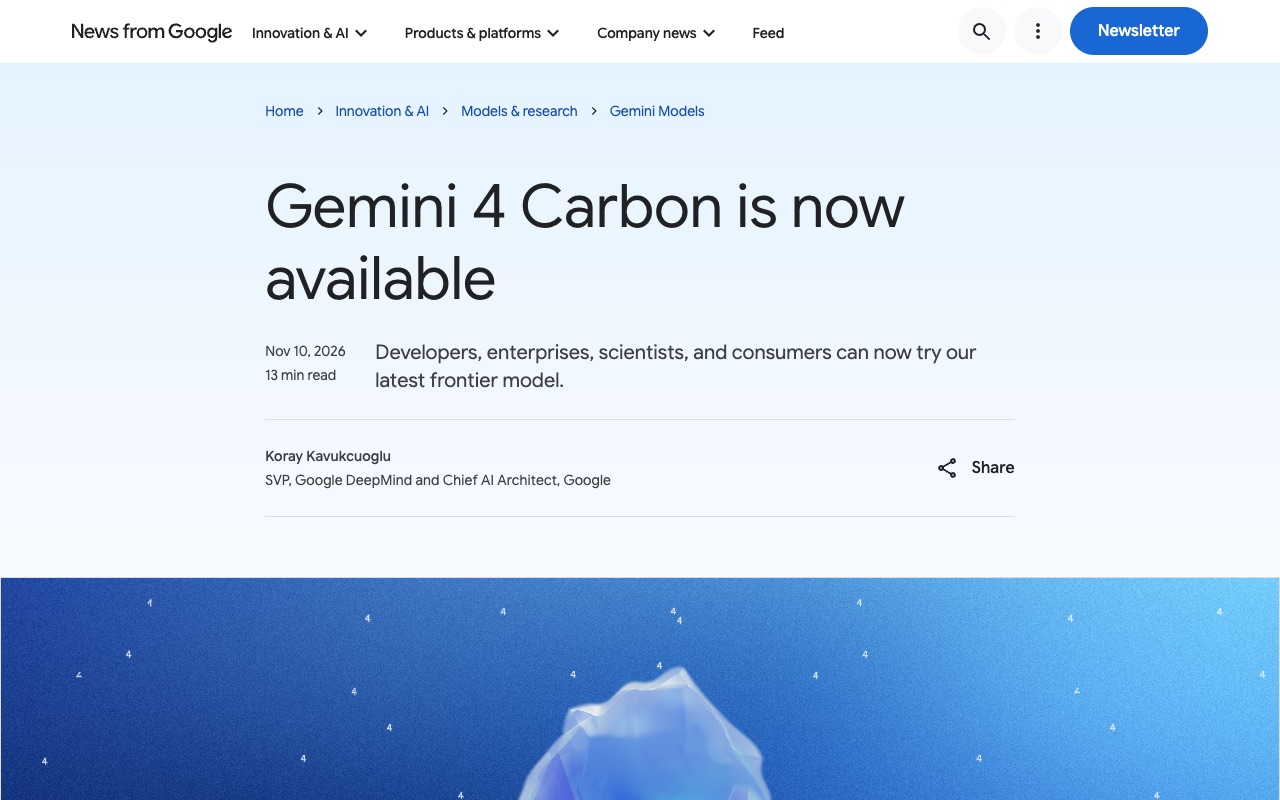
On November 10, 2026 (US time), Google made its top AI model, "Gemini 4 Carbon," generally available. When it was announced on October 28, it was offered only to members of the "Fairwind Program," a vetted program for organizations working in cyber defense. Starting now, developers, businesses, researchers and ordinary subscribers to paid plans can use it.
Where it is available and which plans
According to Google, Gemini 4 Carbon is available in the following places.
- The Gemini API and Google AI Studio for developers (the API is paid tier only and is not available on the free tier)
- Gemini for business and Gemini Enterprise for companies
- The Gemini app, AI Mode in Search, and the development tool Google Antigravity for Google AI Ultra subscribers (rolling out gradually)
For ordinary users, only subscribers to the top plan, Google AI Ultra, can use it for now. Unlike Gemini 4 Argon, which Google AI Pro subscribers could also use once it became generally available, Pro is not included. In Gemini Enterprise, it starts out turned off in the web and mobile apps, and an administrator needs to turn it on. For researchers, Google offers a selective program that lets them use Argon and Carbon free of charge in Antigravity for six months.
API pricing and specs
The model ID in the Gemini API is "gemini-4-carbon." Until November 30, pricing is the same introductory price as Argon, at $2 per 1M input tokens and $10 per 1M output tokens. From December 1, it will be $4 for input and $20 for output.
The amount of text it can handle at once (its context) is about 1M tokens, and you can choose from three levels of how deeply it thinks.
Choosing between Carbon and Argon
Google says Argon is the better fit for most software development and knowledge work. Carbon is meant for work that pushes a model to the limits of its abilities, such as complex programming that spans many steps, tracking down bugs, and open-ended scientific research. It uses more tokens than Argon, takes more time to think, and checks its work repeatedly.
On performance, Google says the following.
- It ranked first on a programming evaluation (CursorBench 4.0), Perplexity's evaluation (WANDR) and Zapier's business automation evaluation (AutomationBench). The cost per task was less than half that of the next-best model from another company
- It ranked second on a new evaluation of reading documents and drawings (Multimodal Knowledge Agent), at less than one-sixth the cost of the first-place model
Google also began a trial of "/swarm," a feature in Antigravity that runs a team of multiple AI agents from a single instruction.
The cyber defense version remains vetted
The version of Carbon that performs especially well in cybersecurity will still be offered only through the Fairwind Program. Google says it will admit defender organizations to the program in stages. For the general version of Carbon, Google says that, thanks to safeguards against misuse, the rate at which break-ins succeeded per attempt in simulated cyberattack tests fell to 0.8%, down from 3.1% for Argon.
CoAI's take
Carbon went from announcement to general availability in two weeks. However, in the Gemini app it is available only on the expensive AI Ultra monthly plan, and Google has not said when Pro subscribers will get access. The API price is the same as Argon's, and it is especially easy to try during November while the introductory price lasts. It is worth testing Carbon and Argon on the same tasks to see which one fits your own use.
This week, Anthropic also released its top model, Claude Fable 5.2. The two companies follow a very similar approach, raising performance while splitting their most powerful capabilities between general access and access for vetted organizations.