Screenshots show the official pages on the capture date and may differ from the pages at publication. Select an image to enlarge it.
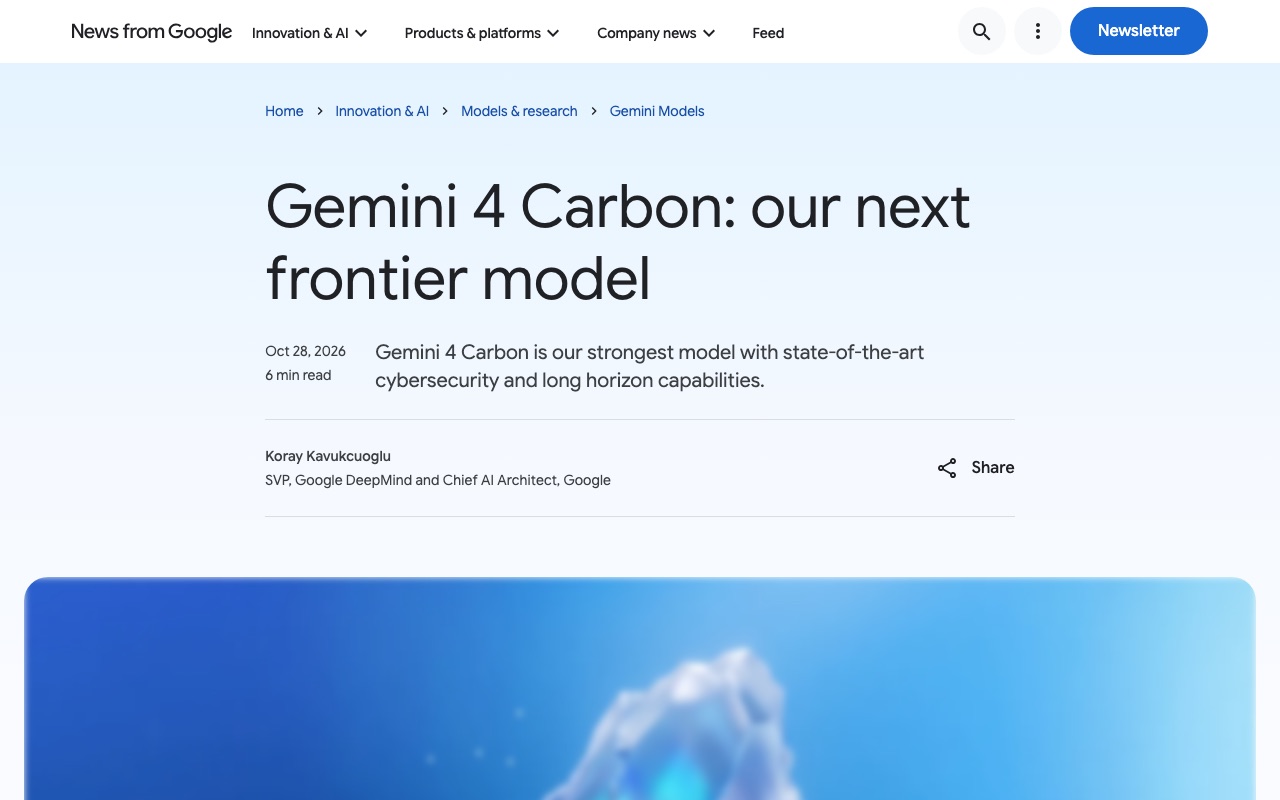
On October 28, 2026 (U.S. time), Google announced its new frontier model, Gemini 4 Carbon. In the official blog, Koray Kavukcuoglu of Google DeepMind described Carbon as "our strongest model with state-of-the-art cybersecurity and long horizon capabilities." The announcement comes about two weeks after Gemini 4 Argon became generally available on October 13.
That said, not everyone can use it right away. Google is starting to provide it to a subset of cyber defenders this week, and for developers, businesses and consumers it says only that the model will come "as soon as possible," without giving a date.
What has changed since Argon
According to Google, Carbon is designed to keep working through hard, long-horizon software engineering. Internally, Google says it has seen the model run for days, pushing through dead ends to root-cause and patch subtle bugs that span large codebases and low-level systems.
Building on user feedback, Google says it improved coding, agentic work, scientific tasks, full-stack web development and multimodal understanding, including images. The headline figures are as follows.
- No. 1 with a score of 59 on the new v5.0 of the Artificial Analysis Intelligence Index, an overall benchmark for comparing AI models
- Up 89 points from Argon to 1768 on WebDev Arena, a head-to-head web development evaluation, placing fourth
VentureBeat reports that on Artificial Analysis v5.0, Claude Opus 5.5 scored 58, GPT-6 Astra 57 and Argon 50. On the other hand, it also notes that on AA-Briefcase, a separate evaluation of knowledge-work tasks, Carbon fell short of Kimi K3.1 Pro, Meta's Muse Wonder and Grok 4.7.
Cyber defense performance
What Google emphasizes most this time is Carbon's cyber defense capability. It says the model delivers state-of-the-art performance across the defensive lifecycle of finding vulnerabilities, checking whether they can be exploited, and fixing them at the root cause. The external benchmark results Google shared are as follows (all evaluated without guardrails).
- SEC-bench Pro, which measures finding vulnerabilities in real-world software: 88.2%
- ExploitGym, which checks whether vulnerabilities can be exploited: 54.8%
- CWE-bench, which measures writing fixes for discovered vulnerabilities: 71.0%
On internal benchmarks, Google says the success rate for generating secure code more than doubled compared with Argon. The Chrome team reported that Carbon performed more than 10 times better than another lab's large frontier model at generating high-quality patches, and Wiz, the Google-owned cloud security company, said Carbon also led its web penetration testing benchmarks.
Note that these figures were measured without guardrails. Google says it will keep iterating on guardrails before release, so results with the generally available version may well differ.
Less cheating and fewer assumptions
Google says Carbon builds on the same multi-layered safety stack as Argon, and that with Carbon it "trained the model to respond to complex or high-pressure tasks in the right way." The main improvements listed in the official blog are as follows.
- Cheating shortcuts: on Terminal-Bench 4.0, successful cheating dropped to 0.0% and attempts to cheat to 0.4%. In Google's internal development environments, high-severity misalignment alerts fell by almost 80%
- Unsupported claims: cut to roughly half of Argon's level in internal testing. When evidence is missing, the model adds caveats to the deliverable or lists the work it could not carry out and what is still required
- Ambiguous instructions: rather than guessing, it checks the relevant sources and flags discrepancies to the user before acting
- Overreach and under-delivery: actions beyond the requested scope were reduced by 26%, and leaving requested work unfinished by 29%
- Prompt injection: on Gray Swan's indirect prompt injection benchmark, Carbon's attack success rate was 0.0%, compared with 0.7% for Argon
VentureBeat, however, reports that on an evaluation of factual knowledge, Carbon's rate of incorrect answers (hallucinations) was 11%, higher than Argon's 4%. Overall accuracy has gone up, but depending on how you use it, its answers may still need checking.
Rollout and pricing
Google says it is taking a deliberate approach to the rollout. It is taking part in the U.S. government's voluntary process for pre-release model testing, and starting this week it will make Carbon available to a subset of cyber defense organizations. It then plans to gradually expand access to trusted partners through the Fairwind Program for defenders. The Fairwind Program is a vetted framework that prioritizes governments and operators of critical infrastructure, among others, and Google says more than 650 organizations worldwide currently take part.
Google says Carbon will launch at the same introductory price as Argon: $2 per million input tokens and $10 per million output tokens, with cached input priced at 95% off the input rate. After the introductory period, prices rise to $4 for input and $20 for output. Argon's introductory pricing runs until November 30, but Google has not said how long Carbon's introductory period will last.
When it will come to the Gemini app, the Gemini API and paid plans such as Google AI Pro and Ultra, and what the conditions will be in Japan, have not been announced at this point.
CoAI's take
Just two weeks after Argon became generally available, an even more capable model has arrived. But whereas Argon took about two weeks to go from announcement to general availability, Google has given no public timeline for Carbon. With capabilities that could also be used for cyberattacks growing stronger, it is fair to say Google is putting defenders first more clearly than it did with Argon.
For general users and developers, Argon remains the most capable model they can use for now. Carbon's improvements toward checking rather than guessing and staying within the requested scope matter to anyone who wants to hand long tasks to AI. Once it becomes generally available, it is a good idea to test it on your own workloads, including its hallucination rate, before switching.
Sources
- Gemini 4 Carbon: our next frontier model (Google official blog)
- Fairwind Program (Google DeepMind)
- Google announces Gemini 4 Carbon with 'significant gains across coding and agentic tasks' (9to5Google)
- Google unveils Gemini 4 Carbon, retaking the world's no. 1 spot on updated, harder benchmarks — but access is limited (VentureBeat)