
Emergent is an AI app builder: you describe the app you want in plain language, and AI agents reportedly assemble everything from the screens to the backend and database, and can publish (deploy) the result. This article walks through how Emergent's pricing works and what to check before you start, based on what we found on Emergent's official website, blog, and tutorials on October 4, 2026 (UTC).
What is Emergent?
Emergent is a service for building full-stack apps by giving instructions to AI agents in a chat. The FAQ on its official enterprise page describes the tech stack of the generated apps as React for the frontend, Node.js or FastAPI for the backend, MongoDB for the database, and Expo (React Native) for mobile apps.
As for the company behind it, the official company information page lists offices in Bengaluru, India, and San Francisco, USA, and gives the legal entity as Agione Technologies Private Limited (India).
Key features
These are the main features we could confirm on the official pages:
- Generating web apps, websites, dashboards, and more from written instructions, and checking them in a preview
- Generating mobile apps for iOS and Android (according to the FAQs on the AI App Builder page and the enterprise page, which say apps use Expo/React Native and can be submitted to the stores via EAS)
- Several build agents (E-1, E-2, E-3). E-3 is an autonomous agent that works through everything from planning to testing over long sessions; as of the official blog post in June 2026, it was a beta limited to the Pro plan
- Publishing apps. By default, an app gets a URL in the form "yourapp.emergent.host", and you can also connect a custom domain (official blog)
- Authentication, databases, payments such as Stripe, and integrations with external APIs (the enterprise page cites "100+ integrations and MCP connections"; this is the vendor's own description)
- Emmy, an in-product chat assistant. The official blog says it is free to use and does not consume credits (as of July 2026, web only)
How pricing and credits work
Pricing and monthly credits by plan
As of October 4, 2026, the official pricing page lists the following main plans for individuals. Prices are in US dollars. By default, the pricing page shows monthly-billing prices; turning on the "Annual" toggle switches to the monthly equivalent for annual billing, along with a discount amount that begins with "Save".
- Free: $0. 10 credits per month
- Standard: $20 per month when billed monthly. With annual billing, the equivalent of $17 per month, shown with "Save $36". 100 credits per month, purchase of additional credits, GitHub integration, private project hosting, and more
- Pro: $200 per month when billed monthly. With annual billing, the equivalent of $167 per month, shown with "Save $396". 750 credits per month, a 1M (1 million) context window, creation of custom AI agents, priority support, and more
- Business and Enterprise: both listed as "Custom" on the pricing page (individual quote, book a demo). SSO, role-based access control, audit logs, deployment to your own cloud (VPC), and more
Note that the FAQ on the homepage says team plans start "from $250 per month", which does not match "Custom" on the pricing page. The pages we checked also did not state the price of additional credits, whether unused credits roll over to the next month, or the refund terms for annual billing. We have not verified the total annual charge, taxes, or the final amount shown at checkout either. The official blog explains that discount display is determined by country and account status, so the amounts you see may differ depending on where and how you view the page. Before you sign up, check the latest pricing page and the checkout screen.
What uses up credits
Based on official information, credits are mainly used in the following ways:
- Building apps: instructions to the agent and the work it does consume credits. An official tutorial shows Emmy answering that a small project management tool built with E-3 "would typically take 100 to 300 credits at this scale". This is only one example and does not guarantee how many credits you will use
- Keeping apps published: an official tutorial (updated November 2025) says it costs "50 credits per month per deployment". This figure does not appear on the pricing page. Another tutorial (July 2026) says that on Pro the first deployment is free, after which keeping the app published costs 50 credits per month
- Agent type: according to the official blog, E-3 uses about 30% more tokens than E-1 for comparable work. We could not find any published conversion between tokens and credits
On the other hand, the tutorial on deployment steps (updated November 2025) says that replacing an existing deployment with a new one, or rolling back, incurs no extra charge, and that taking an app offline stops the ongoing charges.
By our own calculation, the Free plan's 10 credits per month fall short of the 50 credits per month said to be needed to keep one deployment live. The pages we checked did not state whether apps can be published on the Free plan.
Costs for publishing, domains, and databases
According to the official blog, you can search for and purchase a custom domain within Emergent. Registration through IONOS is free for the first year, and IONOS's standard renewal fees apply from the second year onward. A tutorial notes that custom domains are for web apps, and mobile apps do not get a domain.
In addition, according to an official blog post dated September 30, 2026, a feature for moving a published app's database to your own MongoDB Atlas cluster became available to the Pro plan in September 2026. It requires a dedicated M10 or larger cluster, and Atlas usage fees are billed to your own Atlas account. The migration is one-way; returning to an Emergent-managed database reportedly requires a request to support.
Code ownership and commercial use
The FAQ on the homepage says that you own all the code Emergent generates and that you can connect it to GitHub, download it, and host it anywhere. The enterprise page also says the generated code is synced to a GitHub repository, so you can deploy it to other environments or have in-house engineers continue development. However, the pricing page lists GitHub integration as a feature of Standard and above.
On the other hand, with the retrieval method we used, we could not load the full text of the Terms of Service or the privacy policy. As a result, we have not been able to confirm from the actual terms the conditions for commercial use, how intellectual property rights in generated output are handled, disclaimers, or data handling. If you plan to use Emergent for client-facing apps or contract development, check the full text of the terms yourself.
On security, the enterprise page states that Emergent has obtained "SOC 2 Type I and ISO 27001 certification" (another part of the same page says only "SOC 2"). An official blog post about its deployment infrastructure also explains that you can now choose the region where an app is published, to support GDPR compliance. Both are the vendor's own descriptions.
Japanese-language support
Here we look separately at "the display language of the interface (UI)" and "giving instructions in Japanese and generating apps with Japanese-language screens".
As for the UI, every official page we checked was in English, and we found no mention of Japanese display or any language switcher. We could not load the content of the help center (help.emergent.sh).
We also could not find any official statement on whether you can give instructions (prompts) in Japanese or generate apps with a Japanese UI. In our editorial view, if you want to try it, start with a simple one-screen app on the Free plan and check for yourself for garbled characters, broken layouts, and how Japanese input (IME) behaves. Support is offered at support@emergent.sh, but we could not confirm whether it is available in Japanese.
Where it fits and where it doesn't
The following is our editorial assessment based on the specifications we confirmed in official information.
Cases where it is likely to be a good fit:
- Prototyping business apps with screens and a database, such as internal dashboards, customer management, or booking management
- Building and publishing both web and mobile apps within the same service
- Development where the generated code is managed in GitHub and engineers are expected to take it over later
Cases where it may not be a good fit:
- When you need a strict cap on costs (it is hard to know in advance how many credits a build will take, and according to the official tutorials, each published app costs an ongoing 50 credits per month)
- When a Japanese UI or Japanese-language support is a must
- When you cannot use a tool for client work until you have checked the actual wording of its terms of service
Example use case (for illustration, not tested)
The following example is meant to explain how things work; we have not actually built it or tested it.
Imagine a small office building an internal tool to track progress on projects with its clients.
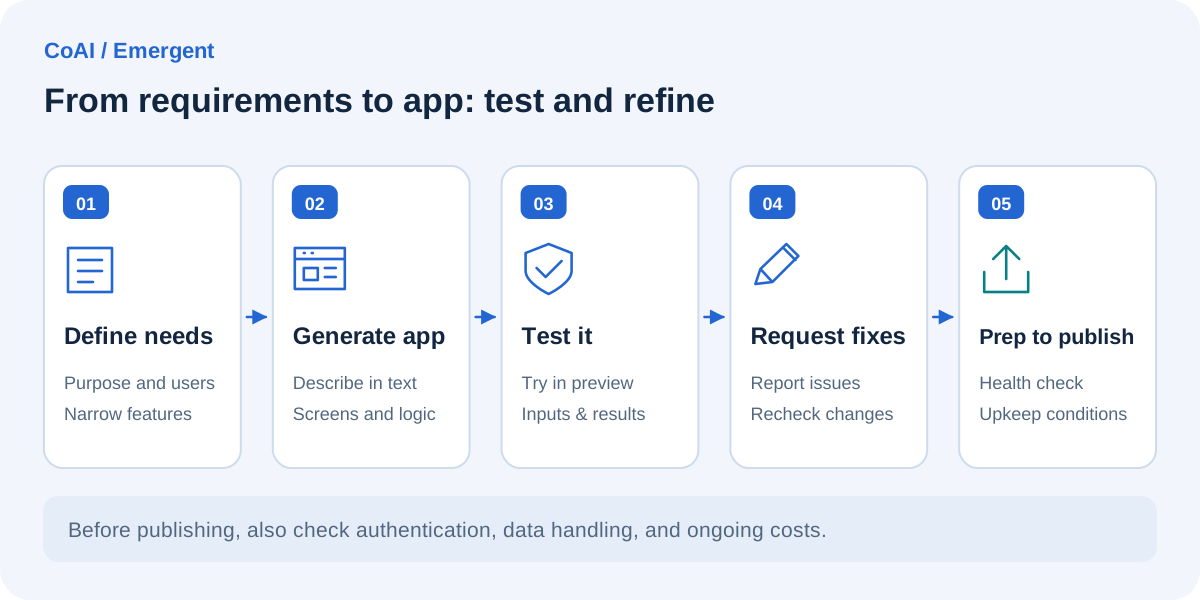
- Tell Emmy, "I want to track project progress for each client," and narrow down the features for the first version
- Using the prompt Emmy produces, choose an agent and start the build (E-3 is Pro only)
- Check how it works in the preview and give additional instructions for any fixes needed
- Run the pre-publish health check, then publish, and connect GitHub to store the code
Going by the official tutorials, this flow costs the credits used during the build plus 50 credits per month for as long as the app stays published. By our calculation, with Standard's 100 credits per month, publishing two apps would use up the entire monthly allowance just to keep them live.
How to choose between Emergent, Lovable, Bolt.new, and Replit
All of these services can build apps from written instructions, but how they count usage for billing and what they do best vary from company to company, and they change often. This article does not cover other companies' prices or specification figures; it only lists points of comparison.
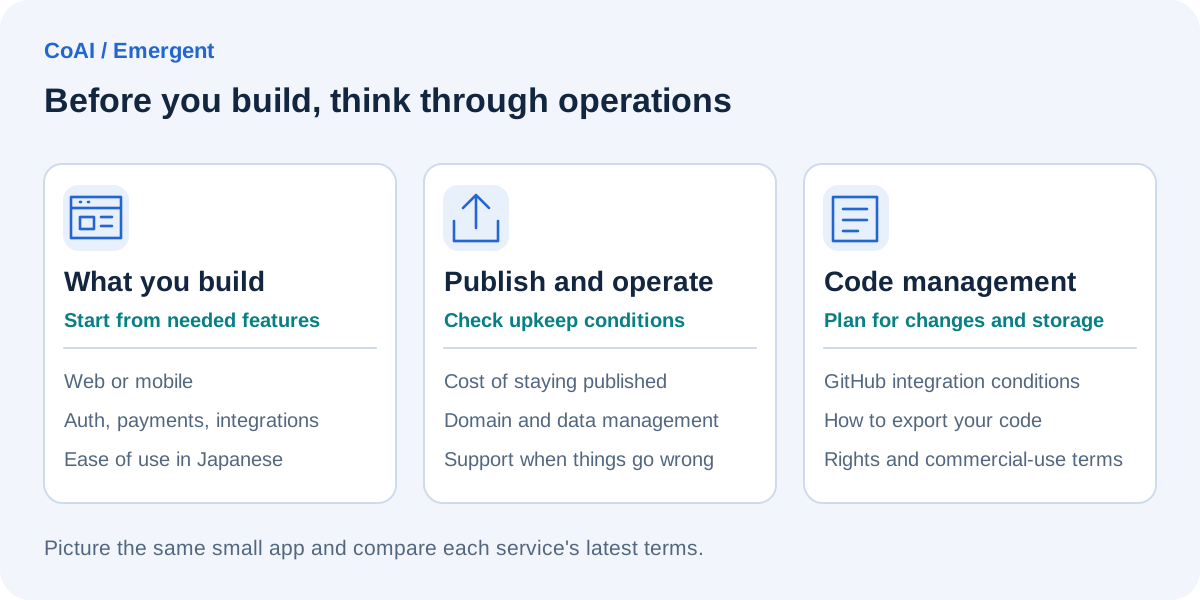
- Billing unit: what credits are spent on (building, keeping apps published, using AI models)
- Post-launch costs: whether each published app incurs ongoing costs
- Taking your code with you: from which plan GitHub integration and downloads are available
- Mobile apps: whether native app generation and store submission are supported
- Japanese: UI language, support for instructions in Japanese, and the language of support
- Terms: whether rights to generated output and conditions for commercial use are clearly stated
You can also find overviews of each service on our Emergent, Lovable, Bolt.new, and Replit pages. Actual costs vary greatly depending on how you use them, so compare the latest pricing pages of each company.
FAQ
Can I use Emergent for free?
There is a Free plan that comes with 10 credits per month. Since the official tutorials say keeping a published app live costs 50 credits per month, a paid plan is likely to be necessary if you want to keep an app published on an ongoing basis (our editorial view).
Can I take the code for my app with me?
The official FAQ says you own the generated code and can connect it to GitHub or download it. On the pricing page, GitHub integration is listed for Standard and above. Keep in mind, however, that we have not been able to confirm this in the actual wording of the terms of service.
Can I give instructions in Japanese?
The official information we checked did not mention instructions in Japanese or a Japanese UI. You will need to try it yourself on the Free plan to find out whether it works.
Date checked and sources
The information in this article was checked on the following official pages on October 4, 2026 (UTC). Pricing and specifications may change, so check the latest information before you use the service. The Terms of Service (app.emergent.sh/terms-of-service), privacy policy, and help center (help.emergent.sh) responded, but we could not retrieve their text, so they are not included in the sources.
- Emergent official pricing page
- Emergent official homepage (FAQ)
- Emergent enterprise page (FAQ)
- Emergent AI App Builder page
- Emergent company information
- Official tutorial: Deploying your first app
- Official tutorial: Building an app with Emmy
- Official blog: Introducing Emmy
- Official blog: Introducing E3
- Official blog: Buying a custom domain
- Official blog: Connecting to MongoDB Atlas
- Official blog: Rebuilding the deployment engine
- Official blog: How pricing and discount decisions work
Tools mentioned in this article
 EmergentAn agent-based platform that builds web and mobile apps from a conversation.View details
 ReplitReplit is an AI web and app development service useful for web app development and prototyping.View details
 Bolt.newBolt.new is an AI web & app development service that can be used for web apps and MVPs.View details
 LovableLovable is an AI web & app development service that can be used for MVPs and web apps.View details