Screenshots show the official pages on the capture date and may differ from the pages at publication. Select an image to enlarge it.
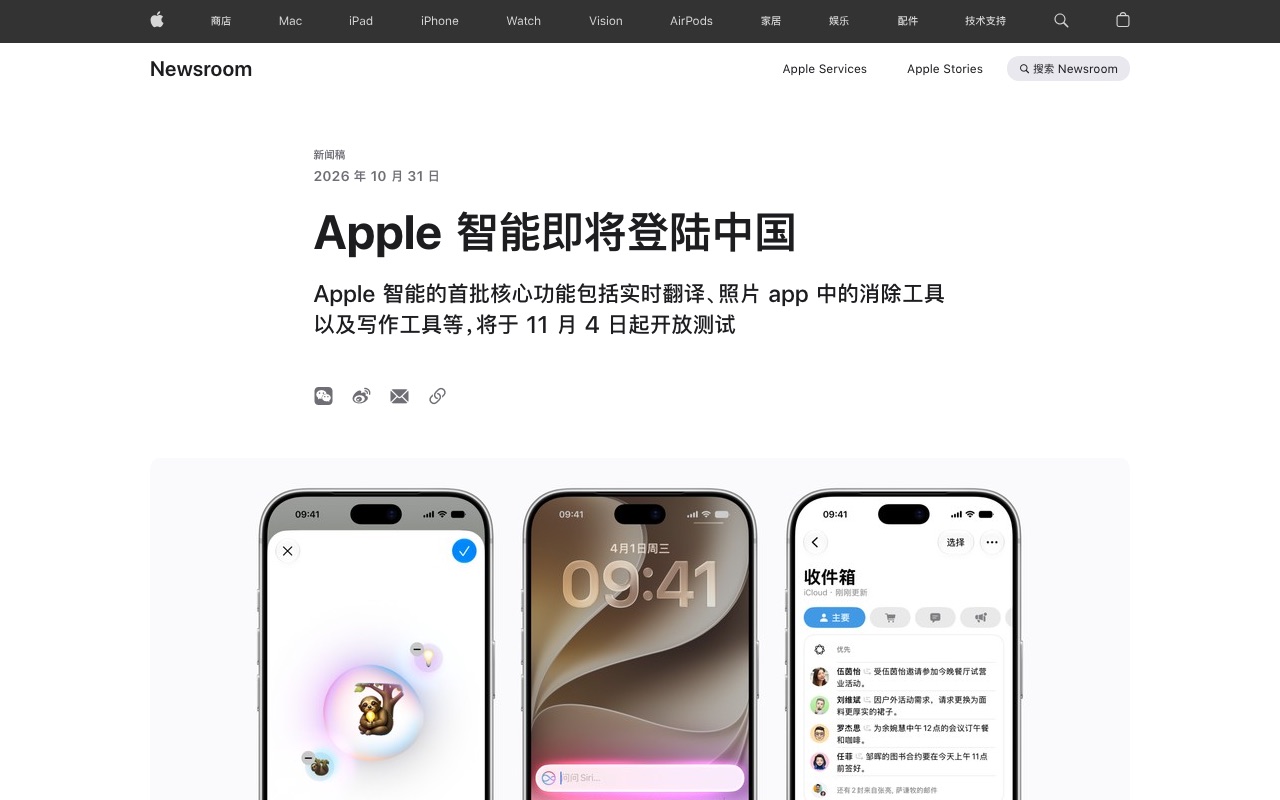
On October 31, 2026 (China time), Apple announced on its China newsroom that it will begin offering Apple Intelligence to users in mainland China. It also revealed a partnership with Alibaba that will let some parts of Siri, Writing Tools and Visual Intelligence use Alibaba's AI model, Qwen. Testing starts on November 4 in the latest iOS developer beta, and the features will reach users in China with the official release of iOS 27.3 in December.
Apple Intelligence was announced in June 2024, but in mainland China it requires regulatory approval and had not been available until now. According to EqualOcean, CEO Tim Cook said in Shanghai on October 15 that Apple Intelligence and the related Alibaba Qwen models had received approval.
The first features available
According to Apple, the first features coming to China are listed below. Apple Intelligence is essentially powered by generative models built by Apple.
- Live Translation: translates conversations in Messages, FaceTime and the Phone app. With supported AirPods, it can also translate in-person conversations
- Writing Tools: rewrites, proofreads and summarizes the text you type
- Visual Intelligence: uses the iPhone camera to learn about objects and places around you
- Clean Up in Photos: removes distracting objects from your photos
- Genmoji: creates original emoji just from a text description
- Natural language search in Photos, and creating a Memory movie from a description
- Priority Messages and Mail summaries in Mail, plus Smart Reply in Mail and Messages
- Notification summaries, Priority Notifications and the Reduce Interruptions Focus
- Transcription of audio recordings in Notes and the Phone app, along with summaries of those transcripts
- Type to Siri. Siri understands what you mean even if you stumble over your words, and keeps track of the conversation
Where Qwen comes in
What sets this rollout apart is that some features call on Alibaba's Qwen. Apple says users can access Qwen directly from Siri, Writing Tools and Visual Intelligence, including for features involving text and image understanding.
- Siri: for certain questions, it draws on Qwen's broad knowledge to answer. You can also ask questions about photos and about documents such as PDFs and presentations
- Compose in Writing Tools: from the systemwide Writing Tools, you can have Qwen write text from scratch
To use Qwen, you sign in with a Qwen account or use Sign in with Apple. Outside China, Apple Intelligence offers optional integration with OpenAI's ChatGPT, and in the Chinese version Qwen takes on that role.
Supported devices, requirements and what is not included
According to Apple, the devices that will get the features in China with iOS 27.3 are iPhone 16 and later, iPhone Duo, iPhone 15 Pro, iPhone 15 Pro Max and iPhone Air. Siri and the device language must be set to English or Chinese (Simplified). Live Translation with AirPods works with AirPods 5, AirPods 4 with Active Noise Cancellation, AirPods Pro 2 and later, and AirPods Max 2 (the latest firmware and pairing with an Apple Intelligence-enabled iPhone are required).
Apple says support for devices other than iPhone will follow once the necessary approvals are obtained. This release also does not include Siri AI or the other next-generation Apple Intelligence features announced at WWDC 2026.
CoAI's take
China is a huge market for the iPhone, yet Apple Intelligence had been unavailable there for more than two years. This announcement settles on an unusual arrangement: a major U.S. company building a Chinese AI model into its own operating system. For Qwen, too, becoming part of the standard features on iPhones used around the world is a significant step.
On the other hand, the Chinese version only gets the first wave of features, and newer capabilities such as Siri AI are not included. The announcement is aimed at users in mainland China, and no changes have been announced to Apple Intelligence in other countries and regions, including Japan.
