Screenshots show the official pages on the capture date and may differ from the pages at publication. Select an image to enlarge it.
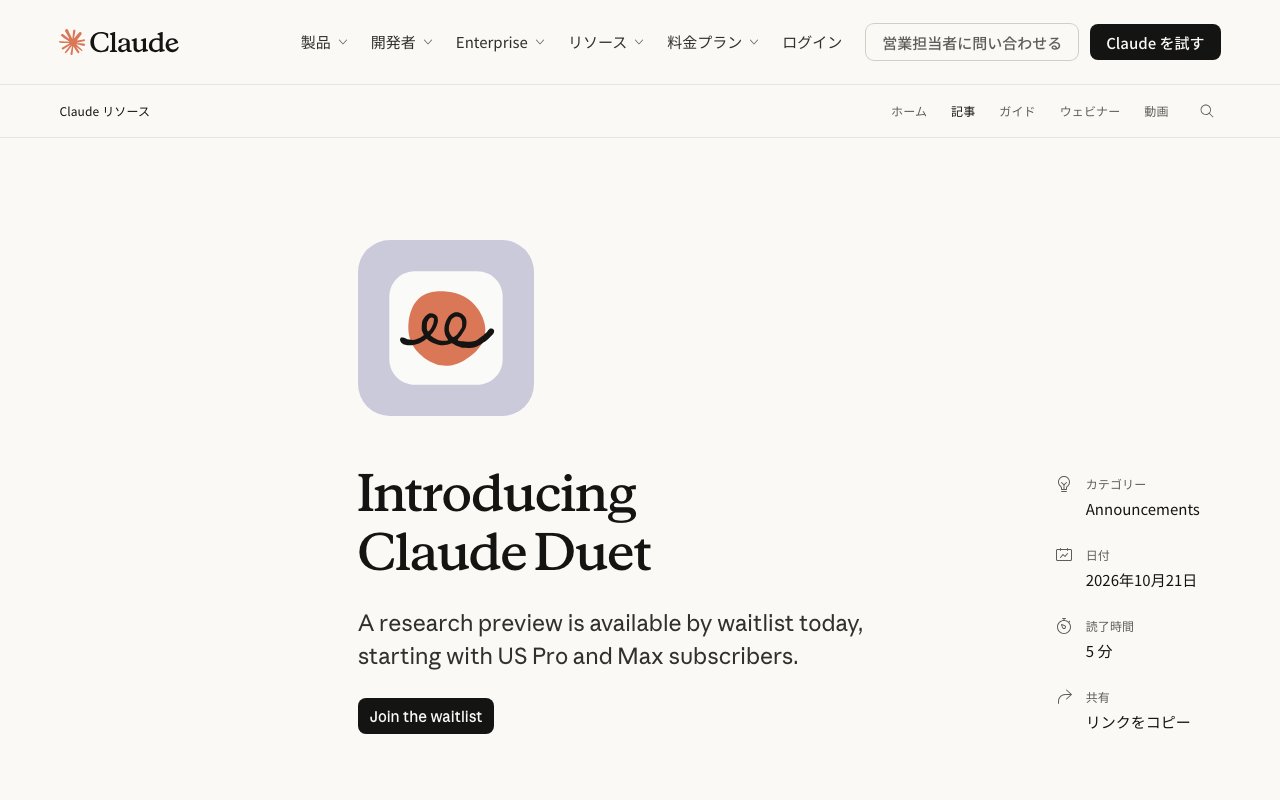
On October 21, 2026, Anthropic announced Claude Duet, an AI agent. An AI agent is an AI that takes instructions and carries out multiple steps on its own, such as researching or operating apps. What sets Claude Duet apart is that instead of waiting for users to talk to it, it keeps an eye on connected apps and reaches out on its own when needed. It is launching as a research preview (an experimental release), opening first to people who sign up for the waitlist.
What Is Claude Duet?
For now, Claude Duet is offered as its own app, separate from the Claude app. Its main functions are:
- Every morning, it sends a short summary of what matters across your connected apps
- It checks your apps every few hours and notifies you only when something needs action
- It takes on everything from administrative chores like scheduling to larger jobs like building a web app
- It keeps working while your computer is closed
Conversations are not split by topic but continue as one ongoing thread. The memories, skills and connected apps saved in your Claude account carry over to Claude Duet as they are. It runs on Claude Opus 5.5, released in September.
Connected Apps and Payments
Claude Duet connects to more than 6,000 connectors and plugins. The examples Anthropic gave include Gmail, Slack, Intuit QuickBooks, Stripe, Gusto, LinkedIn, Docusign, HubSpot, Canva and Shopify.
It does its work with a dedicated browser inside a virtual machine (a dedicated computer in the cloud) provided by Anthropic, so users do not need to keep their own computer switched on. However, users cannot yet see the screen of the browser Claude Duet is using.
For purchases, it can use virtual cards issued by Stripe's Link and Shopify's Shop Pay. Integration with the password manager 1Password is also coming soon.
Approvals and Safety Measures
Claude Duet works on its own judgment, but it always asks for the user's approval before actions such as sending messages, making payments, signing documents or deleting files. It will not trade stocks or move money between accounts, even with approval. Connected apps can be disconnected at any time.
Anthropic lists the following safety measures:
- Passwords and login credentials are handled in a way that keeps them hidden from Claude
- A system that judges whether an action is allowed blocks actions the user has not permitted
- Defenses against prompt injection, where instructions planted in web pages are used to manipulate the AI, are built in
- A new dedicated classifier keeps information such as credit card numbers and ID numbers from leaking. Health and financial information is handled only when the user explicitly instructs it
- Before launch, it was penetration-tested by internal red teams and an external firm, and it is covered by a bug bounty program (rewards for people who report vulnerabilities)
At the same time, Anthropic says it is not yet optimized for personal errands such as booking tickets.
Who Can Use It and Pricing
Claude Duet is available in the iOS and Android apps and on claude.ai. It is first open to people in the U.S. who subscribe to Claude's Pro or Max plan. Those who join the waitlist will gain access in turn. No launch date for Japan has been announced.
There is no extra charge; it runs within the usage limits of Pro or Max. However, the checks every few hours and large tasks such as building financial models or presentation materials consume more of that allowance. Anthropic explains that it set the check interval at every few hours to conserve usage.
How It Differs From dots and Muse
Proactive, "always-on" AI agents have become a competitive field after OpenAI's dots and Meta's Muse were announced one after the other in September. Claude Duet stands out for its emphasis on integration with work apps and for carrying over Claude's memories and skills as they are. Muse launched in Japan on October 23, while Claude Duet is currently limited to the U.S. Differences in pricing and approval mechanisms among the products are laid out in our comparison of dots, Muse, Grok Bot and OpenClaw.
CoAI's take
Claude Duet is a product in which Anthropic clearly signals a shift from asking AI questions and getting answers to handing it work and receiving progress reports and approval requests along the way. Its lines — always asking for approval before payments and signatures, and refusing stock trades from the outset — offer reassurance for use at work.
That said, it is still a research preview, limited to paying subscribers in the U.S. Because it involves connecting important apps such as email and accounting software, even once you have access, it is wise to start by connecting only low-impact apps, see how approval requests arrive, and then widen the scope.