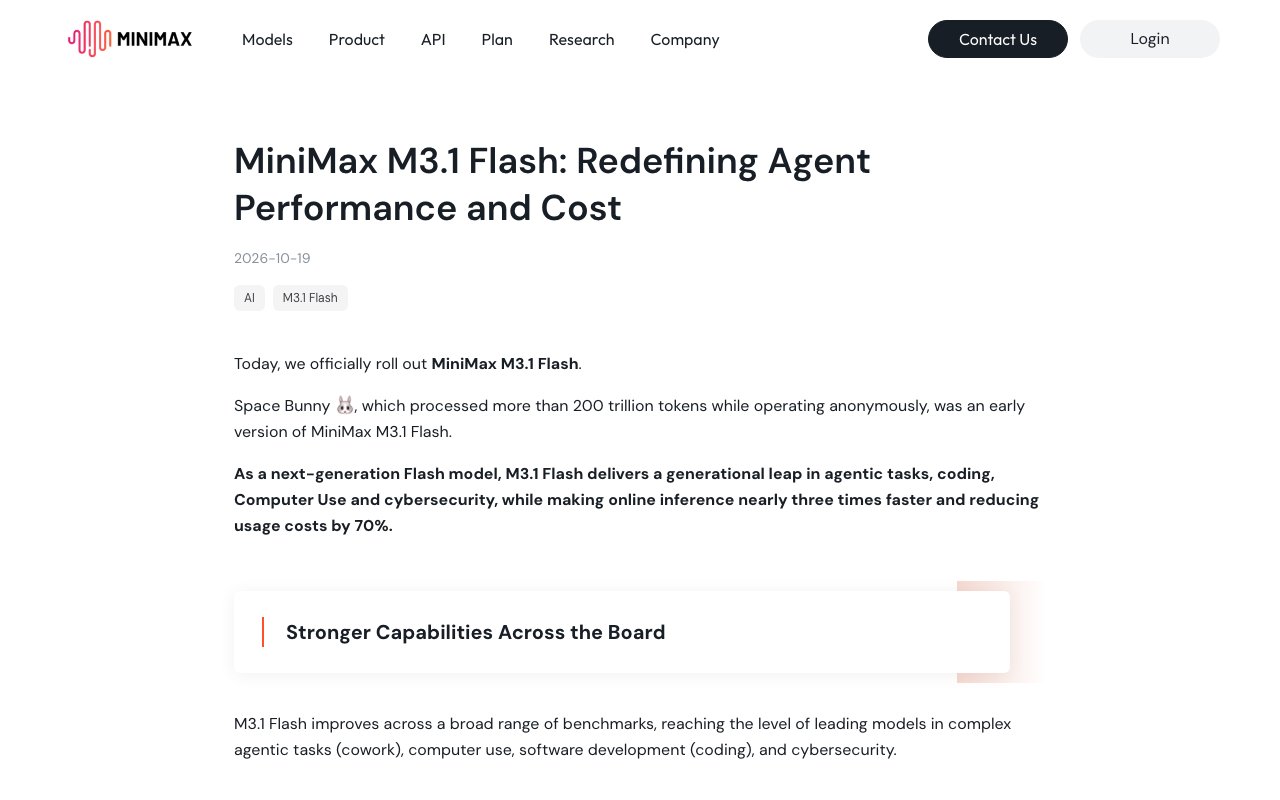
Screenshots show the official pages on the capture date and may differ from the pages at publication. Select an image to enlarge it.
On October 19, 2026, the Chinese AI company MiniMax released "MiniMax M3.1 Flash," a light and fast language model. MiniMax is also the company behind the video generation service "Hailuo AI." The company says the new model is strong at programming and at "agent" tasks, in which an AI plans its own steps and carries out work, and that it is faster and cheaper to use than the previous generation.
MiniMax also revealed that "Space Bunny," a mysterious model that had been offered without a name attached, was an early version of M3.1 Flash.
What kind of model is M3.1 Flash?
In its release notes, MiniMax describes M3.1 Flash as "a highly efficient open-weight model for everyday work." Open weight means the model's weights (the data that makes up the trained model) are made public so that anyone can run the model in their own environment. However, MiniMax says the weights will be "released later," and they were not yet available at the time of the announcement. The company also says a higher-end "Pro" version will come later.
According to MiniMax's official blog, the new model is a big improvement over the previous generation in the following areas.
- Agent tasks
- Programming
- Computer use (where an AI looks at the screen and operates the mouse and keyboard)
- Cybersecurity
On security, MiniMax says the model was evaluated by its in-house security experts and performed well at code auditing, fixing vulnerabilities, penetration testing and analyzing malicious programs.
MiniMax released its flagship language model, "MiniMax M3," on June 1, 2026. M3.1 Flash is a new version in the M3 series, and "Flash" in the name indicates that it is the light and fast version. The official blog does not clearly name the "previous generation" model it was compared with.
Speed and cost
MiniMax describes the speed and cost as follows.
- Inference (the process of producing answers) in real-world services is about three times faster than the previous generation
- Output speed exceeds 200 tokens per second, and stays above 170 tokens even at the median (P50)
- The overall cost of agent workloads is 70% lower than the previous generation
Tokens are the small units an AI uses to handle text. Pricing per million tokens is as follows.
- Input: $0.15
- Output: $0.60
- Cached input (a discount for sending the same content repeatedly): $0.015
On MiniMax's price list, the higher-end MiniMax M3 (for inputs of up to 512,000 tokens) costs $0.30 for input and $1.20 for output. M3.1 Flash is half that price.
Evaluation results
The main results published by MiniMax are as follows. All are figures MiniMax presented in its own announcement, and the official blog does not list the scores of the other companies' models it compared against.
- DeepSWE v1.1 (software development): 73.7%
- BankerToolBench (tool use in financial work): 76.2
- OSWorld V2 (computer use): 61.7
- Agents' Last Exam (hard agent tasks): 29.6
- CyberGym (cybersecurity): 82%
MiniMax says the model ranks first among Chinese models on OSWorld V2 and Agents' Last Exam. It also says the model placed near the top on AutomationBench-AA, which measures business automation.
The identity of the anonymous model "Space Bunny"
In the AI world, companies sometimes release a "stealth model" without their name on it first, watch how users react, and then make an official announcement. MiniMax revealed that "Space Bunny," which had been running anonymously, was an early version of M3.1 Flash and processed more than 200 trillion tokens while its name was hidden.
According to reports, Space Bunny was offered on "OpenRouter," a service that gives access to many AI models in one place.
Where you can use it
M3.1 Flash is available in the following three ways.
- MiniMax's API (the mechanism developers use to call the model from their own apps)
- MiniMax's subscription plan, "M Plan"
- "MiniMax Code," a desktop app for programming
The number of parameters (a measure of a model's size), the amount it can take in at once (its context) and the license have not been disclosed on the official pages. There is also no specific information about use from Japan or support for Japanese.
CoAI's take
M3.1 Flash is a model that puts speed and low cost front and center, at half the price of the higher-end model. For developers who want to run large volumes of programming and agent tasks, it offers a way to keep costs down. Chinese companies keep releasing light, cheap models, such as DeepSeek's V4.1-Flash-1017, and competition in this area is heating up.
On the other hand, the evaluation figures come from MiniMax itself, and the official blog does not include comparisons with other companies' models. The timing of the weights release, the license and the context length are also still unknown. For business use, it is best to test it on your own work and also check the terms of use, including where the data you send is handled.
