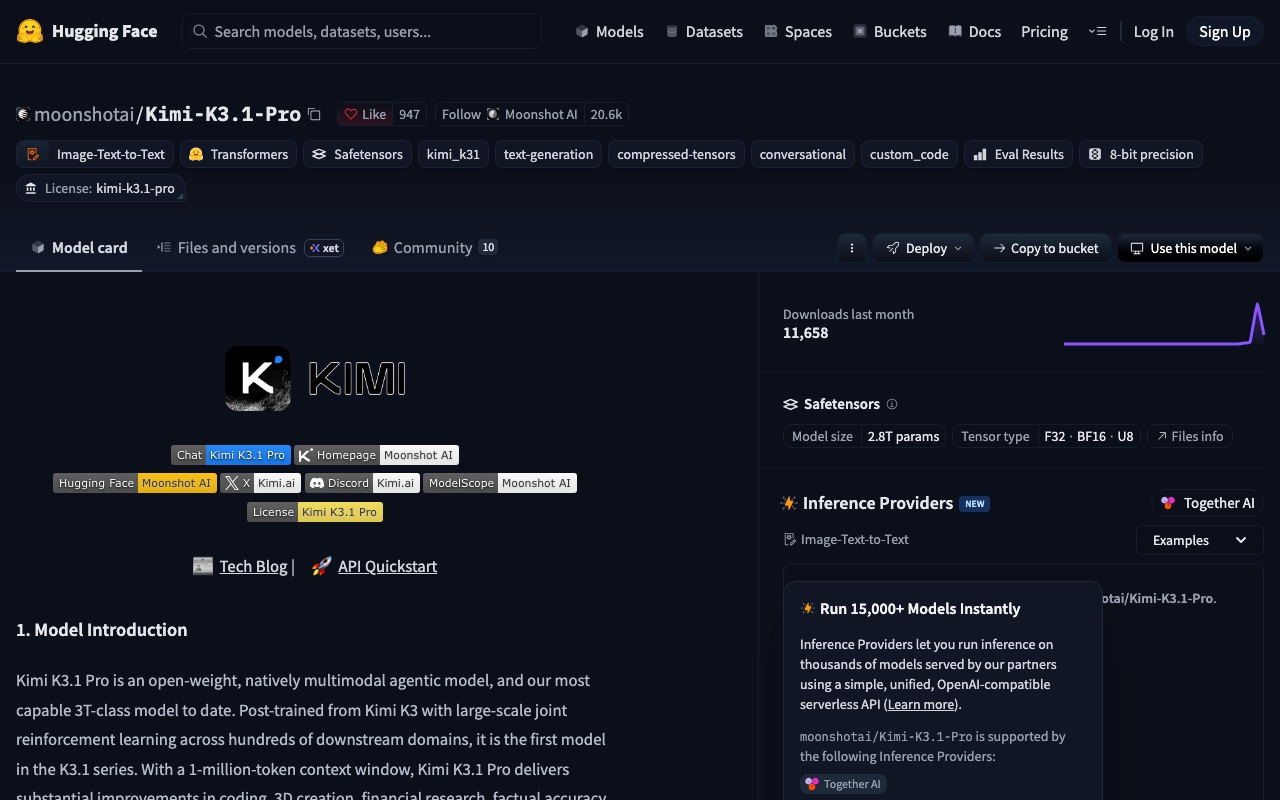
Screenshots show the official pages on the capture date and may differ from the pages at publication. Select an image to enlarge it.
Chinese AI company Moonshot AI released the weights (the data that makes up the model itself) of "Kimi K3.1 Pro," the AI model it launched in October, on Hugging Face by November 4, the deadline it had announced. Hugging Face records show that the repository (where the files are stored) was created on November 2 (UTC). No user registration or application is required, and anyone can download them. CoAI reported this as a plan when the model launched in October, and the release came within that deadline.
The released model
According to the model description on Hugging Face, the configuration is as follows.
- Architecture: an MoE (a mechanism that selects 16 of 896 experts to use) with 2.8T total parameters and 104B active per token
- Context length: about 1M tokens
- Input: text and images (the image-reading component has about 400M parameters)
- Format: weights in 4-bit (MXFP4) and intermediate values in 8-bit (MXFP8), with training done on the premise of this format
- Size: split into 96 files totaling about 1.56 TB
- Supported inference engines: vLLM, SGLang, TokenSpeed
You can choose among three levels of reasoning depth, "low," "high" and "max," with max as the default. On November 5, a fix removed a setting that could not be used (medium).
License conditions
The weights come not with a common open source license but with Moonshot AI's own "Kimi K3.1 Pro License." Commercial use is broadly permitted, but large services face the following conditions.
- Companies running a business that provides AI models to others (MaaS) whose total revenue, including affiliates, exceeds $20M over any consecutive 12 months must sign a separate agreement with Moonshot AI before commercial use
- Products or services with more than 100M monthly active users or monthly revenue exceeding $20M must prominently display "Kimi K3.1-Pro" on screen
Internal use, and use through Moonshot AI's official products or certified inference services, are not subject to these conditions.
On cyberattack capabilities
In its October announcement, Moonshot AI explained that for the version whose weights would be released, it removed cyberattack-related data from both of its two training stages. According to its internal evaluation, the rate at which the model could solve attack-related problems fell from 90.5% to 81.0%.
CoAI's take
Kimi K3.1 Pro is the model Moonshot AI touts as "its most capable 3-trillion-class open-weight model to date," and publishing it within the deadline it announced has boosted trust in the company. However, at 1.56 TB, it is not something that can run on a personal computer. Actually running it requires servers equipped with many high-performance GPUs.
For many companies, the main benefits of the weight release are being able to run it on their own servers without sending data outside, and being able to verify its performance themselves. The license is unlikely to be a major constraint unless you run a large-scale service, but its terms differ from typical open source. Before using it, check the full text of the license.