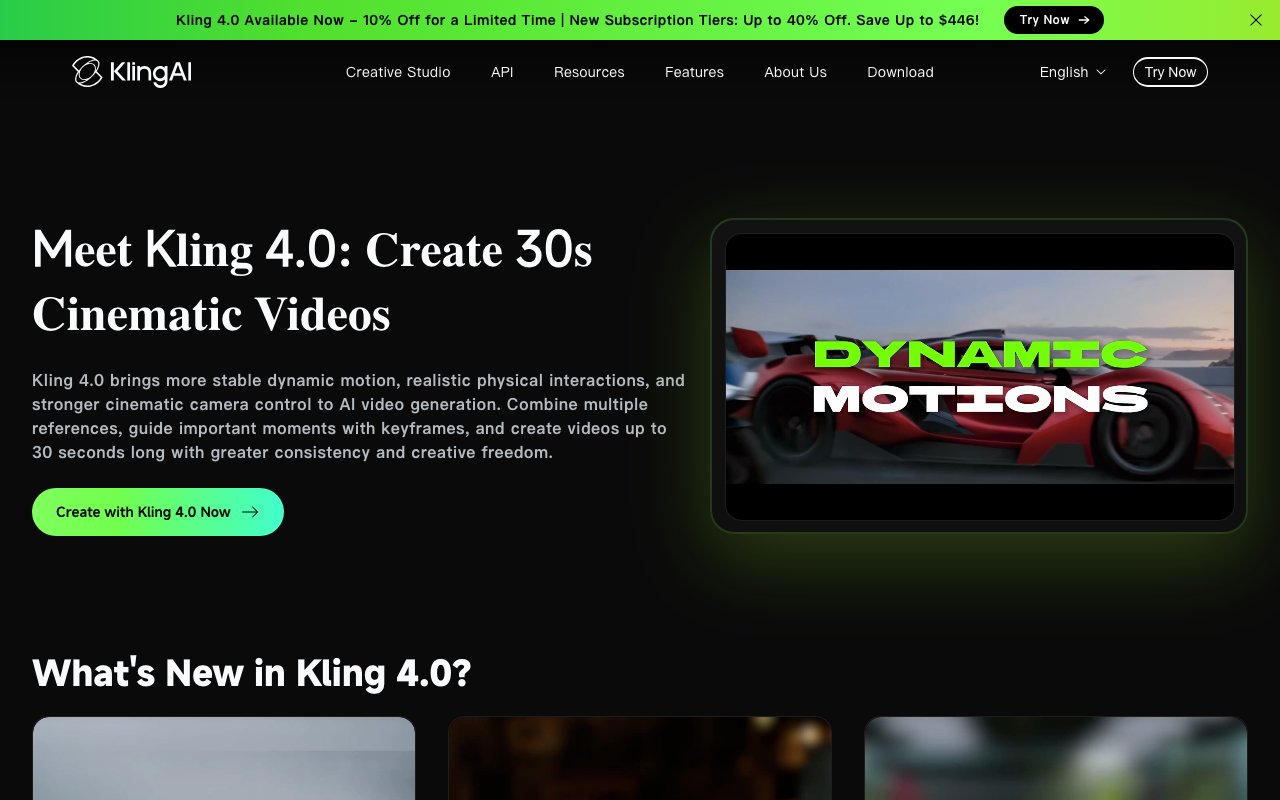
Screenshots show the official pages on the capture date and may differ from the pages at publication. Select an image to enlarge it.
On October 15, 2026, Kling AI (可灵AI), the AI video generation service run by China's Kuaishou group, opened its new video generation model Kling 4.0 to all users. Kuaishou announced it in a press release dated October 16. A single generation can now produce a video of up to 30 seconds, and users can control the content in detail with up to 10 keyframes (images that fix key moments partway through the video) and up to 15 reference materials.
For more on the Kling AI service as a whole, including its features, pricing and terms for commercial use, see CoAI's guide "What Is Kling AI (可灵AI)? Features, Pricing and Commercial Use Terms Based on Official Information."
What changed in Kling 4.0
Kling AI describes the three pillars of this update as "realism, controllability and professional quality." The main changes explained in the official release notes and press release are as follows.
- Stable motion: the company says footage holds together better in scenes with a lot of movement and camera work, such as fast action, tracking shots that follow a subject, and orbit shots that circle around it
- Generation of up to 30 seconds: a single generation can produce a video of 3 to 30 seconds. The company says this suits long takes that run without cuts and videos with a continuous storyline
- Up to 10 keyframes: users can add up to 10 images marking key points in the video to specify a character's state, scene transitions and how the story unfolds
- Long prompts: prompts (instructions to the AI) can be up to 8,000 tokens long
- Stereo audio: it supports two-channel stereo audio, and the company says lip sync, which matches mouth movements to the voice, is also more accurate
- Multiple languages: spoken languages include Chinese, English, Japanese, Korean, Spanish, Portuguese, German, French and Hindi. The company says it can also handle accents such as Beijing-accented Mandarin, Cantonese, and American, British and Indian English
- On-screen text: the company says it can show text in various languages, including Japanese, as well as emoji and logos legibly even when the camera moves
All of these are Kling AI's own descriptions. The announcement materials include no benchmark figures comparing it with other AI video models.
Omni Reference, which combines up to 15 reference materials
Omni Reference is a feature that combines reference materials such as images and videos to keep characters' appearance, movement and camera motion consistent. With Kling 4.0, a single generation can use up to 15 of the following materials in total.
- Images: up to 10. Three-view character sheets showing a person from the front, side and back, storyboards and wireframes (rough sketches showing only the layout) can also be used
- Videos: up to 5 (up to 30 seconds in total). They can serve as references for a character's acting and movement, camera motion and the pacing of the story. Videos of untextured 3D models and depth map videos that represent depth can also be used
- Elements (registered characters or objects): up to 7. Of these, up to 3 can be created from video, and a voice can also be specified
The company says it has also strengthened Creative Recreation, which swaps out the products or people in a reference video while keeping its pacing and composition.
Status of resolution and HDR support
On resolution, the official pages are not consistent. The spec table in the release notes lists 720p, 1080p and 4K resolutions and support for 10-bit HDR, which records a wider range of color. However, the body of the same release notes says "10-bit HDR output in 4K and 1080p is coming soon." The Kling 4.0 introduction page says that 1080p and 4K output themselves are "coming soon."
Supported aspect ratios are 21:9 (a wide, cinema-like format), 16:9, 1:1 and 9:16. The surest way to know whether you can generate in 4K right now is to check the generation screen in your own account.
In addition, "video extension," which lengthens a generated video in several steps to up to 2 minutes, is also listed as coming soon.
Kling 4.0 Flash, built for speed
Alongside it, Kling AI has released Kling 4.0 Flash, a lightweight version aimed at work that involves many rounds of trial and error. The company says it generates faster and is affordable to use. Its specs are more modest than the standard version: videos are 3 to 20 seconds long, resolution is 720p, and color is standard 8-bit SDR.
According to the Chinese business newspaper 21st Century Business Herald, Kling AI announced on September 28 that it would release Kling 4.0 in October, and from that point it had been letting some users try the Flash version in advance.
Where to use it: the web, MCP and CLI, with the API coming soon
Kling 4.0 can be used by selecting it as the model on the video generation screen at kling.ai. The generation screen has also been redesigned, so image, video and audio reference materials can now be placed together in a single input field. The list view switching, a feature for creating while checking everything on a single timeline, and the canvas and agent features for building workflows by connecting nodes have also been updated.
Kling 4.0 also now supports MCP, a common mechanism that lets AI agents use external tools, and the CLI, which is operated with commands. The company says video generation with Omni Reference and keyframes can be run automatically from agents.
On the other hand, the API that developers and businesses use to build Kling into their own services is described as "coming soon." As of October 20, 2026, Kling's API pricing page stated that "these plans do not currently support Kling 4.0."
Pricing and availability in Japan
When we checked kling.ai's pricing page (monthly display) on October 20, 2026, there were four plans, Standard, Pro, Premier and Ultra+, and the benefits for Pro and above showed "Kling 4.0 limited-time 10% off." The Kling 4.0 introduction page also mentions a limited-time 10% discount. However, we could not find on the official pages how many credits Kling 4.0 uses per second. Displayed prices change over time and with discounts, so please check in your own account before using it.
For reference, the official guide for the previous model, Kling VIDEO 3.0, states that "1080p with audio costs 12 credits per second."
As for availability in Japan, there is no notice restricting particular regions. The language switcher on the pricing page includes Japanese, and the company says Kling 4.0 supports speech and on-screen text in Japanese.
How it differs from Kling 3.0
On its introduction page, Kling AI summarizes the differences from 3.0 as follows.
- Length per generation: from 15 seconds to 30 seconds
- Keyframes: up to 10 can now be specified
- Reference materials: up to 15 in total can now be combined
- Better quality for fast motion, physical motion such as objects colliding, camera work and generation using reference materials
In the official VIDEO 3.0 guide dated February 6, 2026, generation length was 3 to 15 seconds, resolution was 1080p and 720p, and the main feature was specifying the first and last images. The big differences in Kling 4.0 are that the length has doubled and scenes partway through can now be set in detail.
CoAI's take
The biggest change in Kling 4.0 is that it can now produce up to 30 seconds in one go, and keyframes and reference materials let users decide in detail "what happens in which scene." Rather than just creating short, striking scenes, this update is clearly aimed at making videos and ads with a storyline. Support for MCP and CLI is also a move in step with the trend of handing video production to AI agents.
On the other hand, the official pages describe 4K and HDR support differently, and video extension and the API are still at the "coming soon" stage. The improvements in image quality are also Kling AI's own claims, and no outside evaluations have appeared yet. For business use, it is best to try generating at the resolution and length you actually need, and check the credits used and the results before deciding.
Sources
- Meet All-New Kling 4.0! (Kling AI Release Notes)
- Kling 4.0: 30s AI Videos & Cinematic Motion (Kling AI)
- Kling AI Officially Launches Next-Generation Kling 4.0, Raising the Bar for Professional-Grade Video Models (Kuaishou Technology)
- Membership Plans (Kling AI)
- Kling API Pricing (Kling AI)
- Kling VIDEO 3.0 Model User Guide (Kling AI)
- Kling 4.0发布,可灵AI的估值凭什么反超母体快手? (21st Century Business Herald)
- Kling 4.0 Released: Why Has Kling AI's Valuation Surpassed Its Parent Company Kuaishou? (36Kr)