
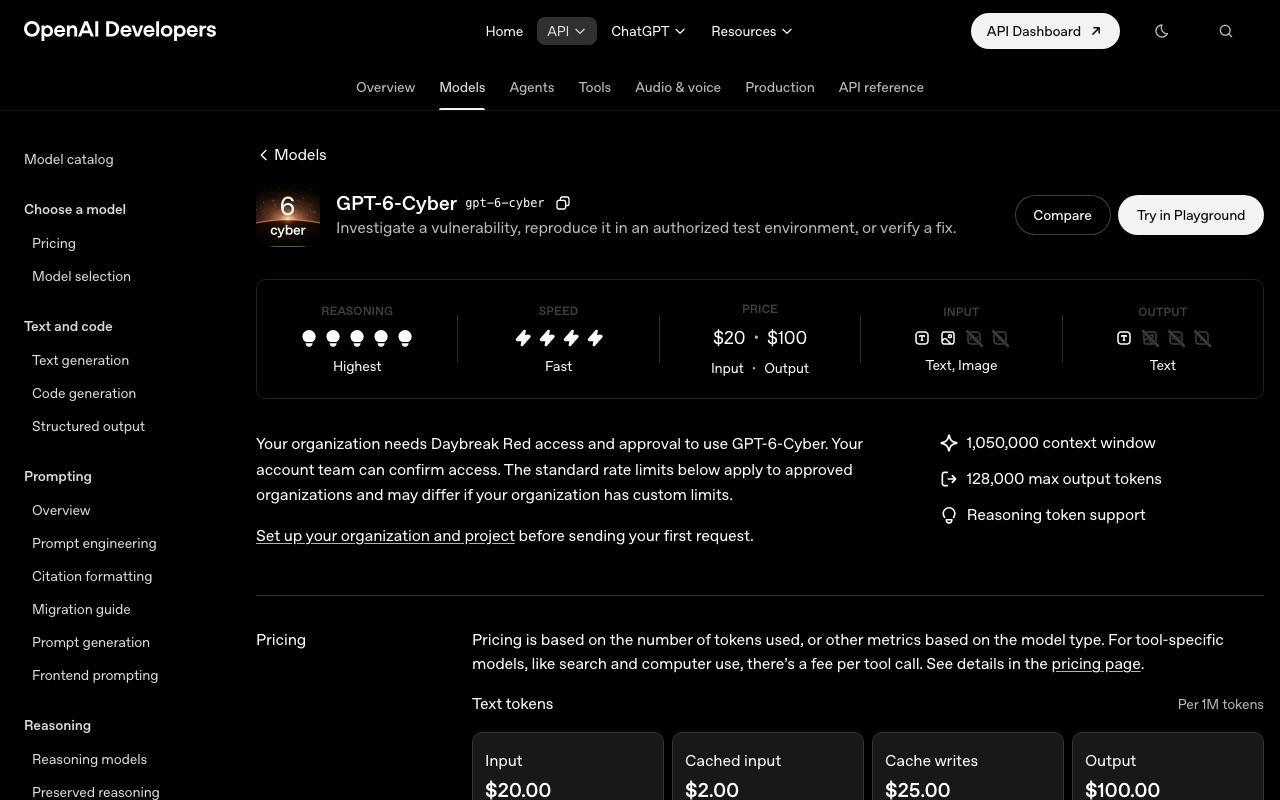
Screenshots show the official pages on the capture date and may differ from the pages at publication. Select an image to enlarge it.
On November 5, 2026, OpenAI released "GPT-6 Cyber," an AI model built specifically for security work. It helps find software vulnerabilities (flaws that can be exploited in attacks), check whether they can actually be exploited, and draft and test fixes. OpenAI calls it its most capable security model to date, and the one that best stays within the scope it is given.
What GPT-6 Cyber can do
According to OpenAI, GPT-6 Cyber is designed to help security researchers with tasks like these.
- Investigating vulnerabilities and reproducing them in authorized test environments
- Checking whether a vulnerability can actually be exploited and how far its impact reaches
- Drafting fixes and checking, before release, that they hold up against other attack paths
Using the model, OpenAI researchers found 81 previously unknown, high-severity vulnerabilities in the Firefox browser, and Mozilla has already begun shipping fixes. In the Linux kernel (the core of the operating system), the model reproduced 1,724 vulnerabilities and produced working exploit code for 948 of them. Of those 948, 588 had not been known before. OpenAI says it has reported 304 of the most serious Linux issues to developers along with proposed fixes.
Training to stay within "authorized scope"
For a model that can handle attack techniques, it is critical that it does not attack targets it was never asked to touch. OpenAI says it trained GPT-6 Cyber to operate only within authorized scope, respect restrictions and report its results accurately.
In an evaluation designed to test this (ExploitGym Honeypot), the model is given a difficult attack task while a service that is "easy to break into but off-limits" sits nearby. Without any safety instructions in the prompt, the model went out of scope 0.07% of the time, down sharply from 5.51% for the previous model, GPT-5.6 Cyber. With safety instructions, OpenAI says it stayed within scope in every trial.
At the same time, OpenAI rated GPT-6 Cyber's risk in the cybersecurity domain as "Critical," the highest level under its internal safety framework (the Preparedness Framework). GPT-5.6 Cyber had been rated one level lower, at "High." On an evaluation that tests exploiting vulnerabilities (ExploitGym), it scored 48.5%, ahead of GPT-5.6 Cyber's 32.1%.
Who can use it and pricing
GPT-6 Cyber is offered through "Daybreak Red," the part of OpenAI's security support program "Daybreak" aimed at organizations that do exploit validation and authorized penetration testing. At first, only a limited number of vetted organizations within that program can use it, through the API and the coding tool Codex. OpenAI says it will expand access to all of Daybreak Red soon. It is not available to general ChatGPT users.
API pricing is $20 per 1M input tokens and $100 per 1M output tokens. The amount of text it can handle at once (its context) is 1.05M tokens.
OpenAI also says it has created a Daybreak Red group for organizations that protect critical infrastructure such as power grids, and strengthened safeguards against attacks on industrial control systems.
CoAI's take
The ability to find vulnerabilities with AI helps defenders and attackers alike. OpenAI's decision to limit access to vetted organizations and to publish numbers on its scope-keeping training reflects an awareness of both sides. According to Mozilla, serious flaws were still found in Firefox even though it has been examined by generation after generation of AI tools. This suggests that many undiscovered flaws likely remain in everyday software.
Fixing those flaws, however, takes time. According to reports, the page where OpenAI publishes the status of fixes shows that fewer than 25% have been patched so far. For ordinary users and businesses, keeping operating systems and browsers up to date is more important than ever.