Screenshots show the official pages on the capture date and may differ from the pages at publication. Select an image to enlarge it.
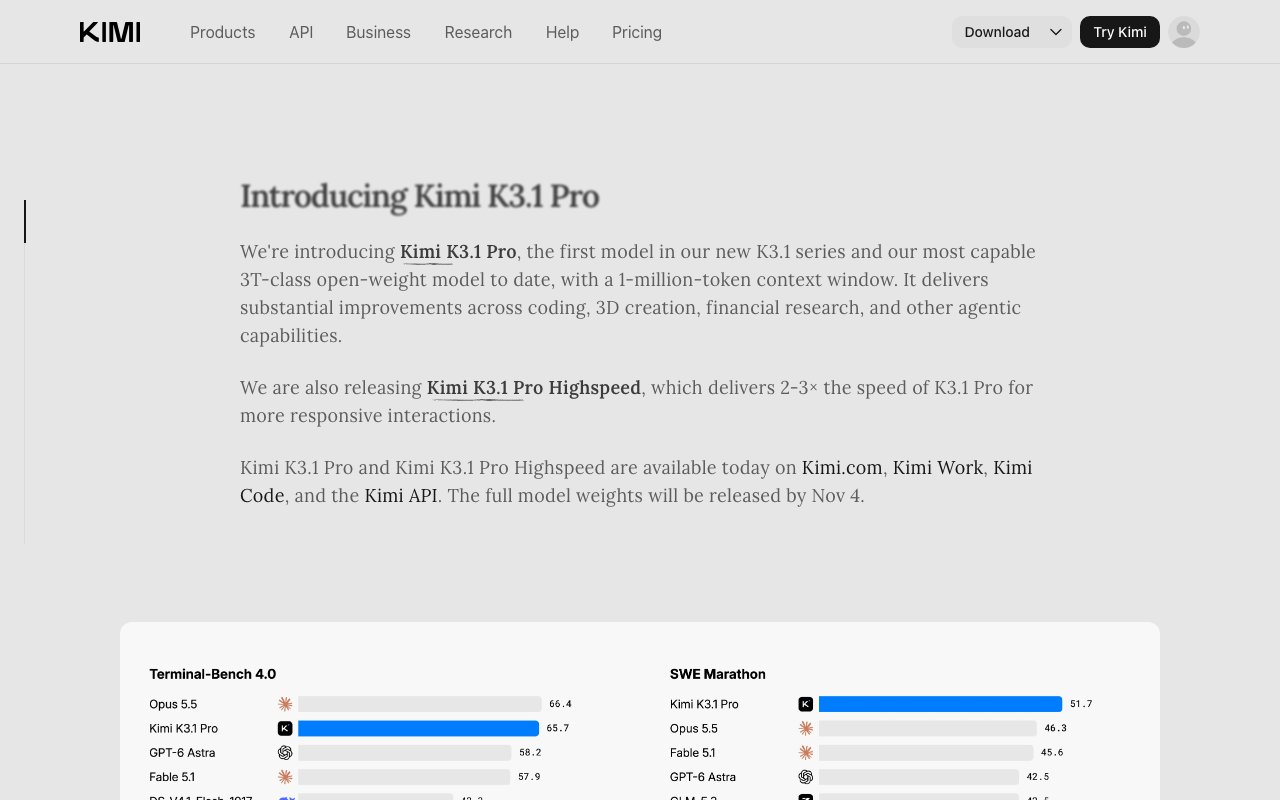
Chinese AI company Moonshot AI released a new AI model, Kimi K3.1 Pro, on October 24, 2026. It also launched Kimi K3.1 Pro Highspeed, which responds two to three times faster. Both are available from day one in the Kimi.com chat service, the Kimi smartphone apps and the API. The international site, Kimi.com, can also be accessed from Japan. The model weights, which make up the model itself, are scheduled to be released by November 4.
What is Kimi K3.1 Pro?
Kimi K3.1 Pro is the first model in the new K3.1 series. Moonshot AI describes it as its most capable open-weight model to date, in the 3-trillion-parameter class, meaning the weights are made public. It can handle 1 million tokens of text at once (its context window).
It is built on Kimi K3, released in July. Moonshot AI finished it by greatly expanding the additional training done after pretraining (post-training). The company says it rebuilt its training system so that reinforcement learning, in which the model learns through trial and error, can run across hundreds of domains at the same time.
Where it got stronger
Moonshot AI says performance improved significantly in areas such as coding, 3D creation and financial research.
- Coding: handles everything from fixing real-world code to building entire projects, and is fluent with game engines such as Unity, Unreal Engine and Godot
- 3D: reads shapes and proportions from text, sketches or reference images to produce usable 3D models, and can write and run its own scripts to drive Blender and CAD software
- Finance: carries out end-to-end workflows, from analyzing financial documents to investment research
- Accuracy: on a demanding internal test made up of questions designed to provoke factual errors, the per-claim error rate fell from 23.4% for K3 to 8.3%
Alongside the model, Moonshot AI launched 3D Make on Kimi.com and in the apps, which lets users view and edit the 3D models they create online and save them for 3D printing.
How it compares with rival models
According to figures published by Moonshot AI, K3.1 Pro scored 65.7% on Terminal-Bench 4.0, which measures agentic coding ability. That beats OpenAI's GPT-6 Astra (58.2%) and falls just short of Anthropic's Claude Opus 5.5 (66.4%).
On BenchCAD, which tests reproducing 3D CAD data from images, it scored 92.7% with tool use. That is close to Claude Opus 5.5 (96.2%) and GPT-6 Astra (95.9%), but still below both. All of these results were announced by Moonshot AI itself and have yet to be independently verified.
Deliberately holding back cyberattack skills
The most striking part of the announcement is how the company handled cybersecurity. According to Moonshot AI, the more it trained the model, the better it became at finding and exploiting software weaknesses (vulnerabilities). When the company looked into why, it found that its general training data contained material related to cyberattacks.
So for the open-weight version, it removed cyberattack-related data from two stages of training. In internal tests, a version trained without that removal solved 90.5% of the problems, while the released K3.1 Pro solved only 81.0%. Moonshot AI says K3.1 Pro's offensive capability is lower than that of rival frontier closed models that have been publicly available for at least three months.
At the same time, the company argues that letting anyone run a high-performing model on their own hardware helps teams that want to audit their own code for defensive purposes.
Where to use it and what comes next
Kimi K3.1 Pro and the Highspeed version are available in the following places.
- The Kimi.com chat service and the Kimi apps for iOS, Android and HarmonyOS
- The Kimi Work desktop app (Windows and Apple silicon Macs, version 3.1.0 or later)
- The Kimi Code coding tool
- The Kimi API (model names kimi-k3.1-pro and kimi-k3.1-pro-highspeed)
The API offers a setting that does not store data (zero data retention). According to the API documentation, using K3.1 Pro requires a minimum deposit of 1 dollar. The terms of use (license) that will apply when the weights are released have not yet been announced.
According to the API pricing page, the previous-generation K2 series will no longer be offered to users who sign up from October 31, and is scheduled to be fully retired by the end of December.
CoAI's take
Kimi K3.1 Pro shows that a major Chinese AI model can now deliver performance quite close to America's frontier closed models, and do so with open weights. Because it is available on the international Kimi.com site and in the apps, users in Japan can test its performance right away.
What stands out is that, in releasing the weights, Moonshot AI explained with concrete numbers how it deliberately lowered the model's offensive capabilities. The safety of open models has become a challenge for every company, and this offers one approach. However, the performance and cyber-capability evaluations rely mainly on Moonshot AI's internal tests. For business use, it is best to check the data handling and terms of use, and wait for the weights to be released and for outside evaluations before making a decision.