Screenshots show the official pages on the capture date and may differ from the pages at publication. Select an image to enlarge it.
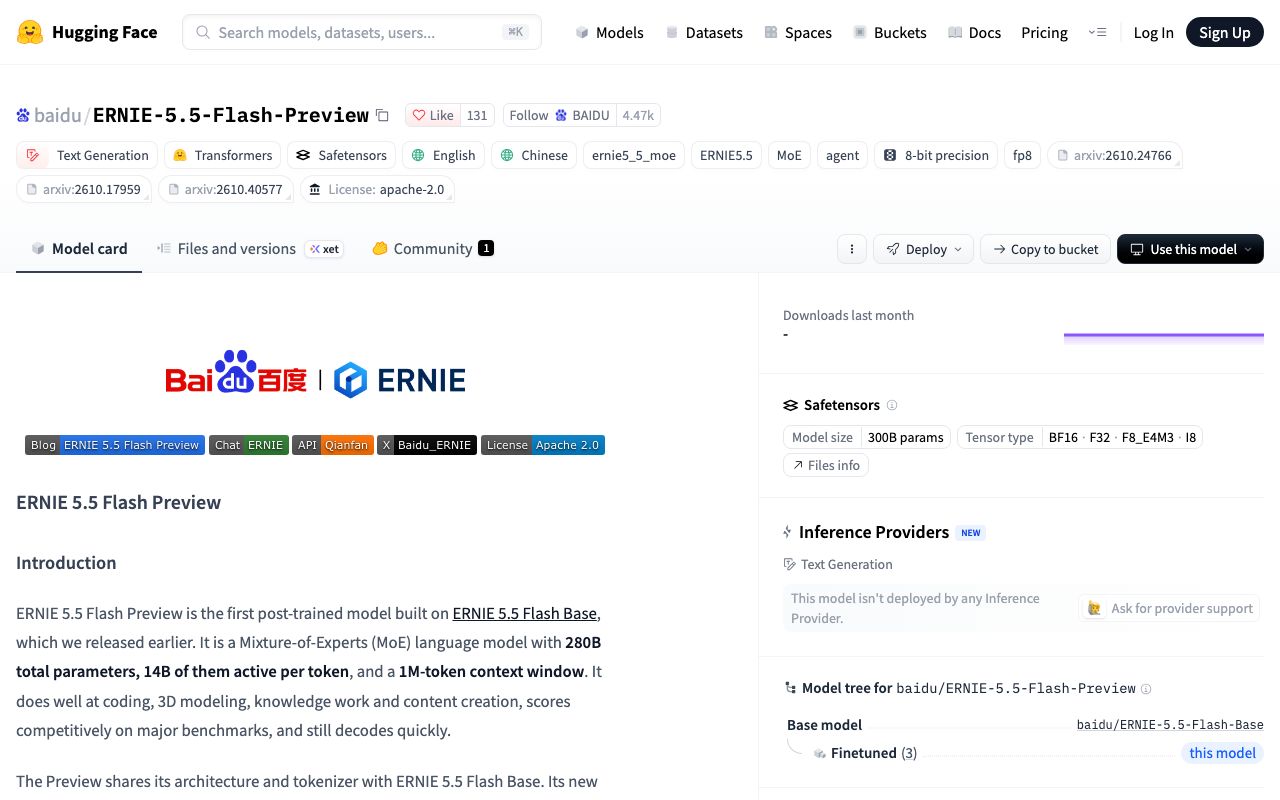
On November 23, 2026, the Chinese tech giant Baidu released the weights (the model's underlying data) of its AI model "ERNIE 5.5 Flash Preview" on Hugging Face. It builds on the base model "ERNIE-5.5-Flash-Base," whose weights were released on November 5, with additional training so it can answer questions and carry out tasks. Baidu announced the model and began offering it through its API on November 11, saying at the time that it would "release the weights by November 25." This release delivers on that promise.
What has changed from the base model
The earlier ERNIE-5.5-Flash-Base had only learned language from large amounts of text and was not suited to conversation as is. The Preview adds mid-training and final-stage training (post-training) so it can follow instructions and carry out tasks. The main differences are as follows.
- Purpose: Base is a foundation for further training. Preview is a model for AI assistants that can be used as is
- Amount of text it can handle at once: Base was trained on up to 128,000 tokens, while the Preview's context was extended to 1 million tokens during training
- Thinking: the Preview is designed to always think (reason) before answering, and its reasoning is returned separately from the answer
- License: Base used Baidu's own license with regional and revenue conditions, while the Preview uses Apache 2.0
The architecture and scale are the same as Base: an "MoE" configuration with 280 billion total parameters, 14 billion of which are active per token. It also shares the same unit for splitting text (tokenizer), so Baidu says tools built for Base can be used as they are.
Baidu positions the Preview as "a version midway through post-training." Training is still continuing, and Baidu says it will make improvements in the official release based on how the model is actually used and on user feedback.
Strengths and performance
Baidu says the Preview excels at programming, 3D modeling, knowledge work such as writing documents, and video production. As examples, it cites building a complete third-person action game over 11 hours in the game engine Unreal Engine 5.8, making nearly 100 mini-games for smartphones from game design documents, and writing programs to drive the 3D software Blender and CAD to create 3D models of an airport, a temple and an engine.
Performance was compared on 20 evaluations against Tencent's Hy4, DeepSeek-V4.1-Flash, Zhipu AI's GLM-5.3 and GLM-5.3-Flash, OpenAI's GPT-6.1 Sol and Anthropic's Claude Opus 5.5. All of the Preview's scores come from Baidu's own evaluations.
- Terminal-Bench 4.0, which tests development through commands: 46.5 (Hy4: 44.4, DeepSeek-V4.1-Flash: 42.3, GPT-6.1 Sol: 56.1, Claude Opus 5.5: 66.4)
- AutomationBench, which tests business automation: 61.9 (the highest of the 7 models compared)
- DeepSWE v1.1, which tests fixing real software: 71.2 (DeepSeek-V4.1-Flash: 77.0, Hy4: 74.9)
- BrowseComp, which tests answering by searching the Web: 87.4 (Hy4: 91.8, Claude Opus 5.5: 90.8)
On some items it matches or beats Chinese models of similar size, but on others Hy4 or DeepSeek come out ahead, and on some evaluations the gap with GPT-6.1 Sol and Claude Opus 5.5 is large.
Weight versions and how to use them
Three sets of weights have been released.
- ERNIE-5.5-Flash-Preview: the standard version. Most of the weights are compressed to 4 bits, so it runs light and fast
- ERNIE-5.5-Flash-Preview-FP8: for hardware that does not support 4-bit computation
- ERNIE-5.5-Flash-Preview-BF16: the version recommended as a starting point for further training
Every version includes a mechanism called "DSpark" that predicts several upcoming words at once to speed up output. To run it, you use SGLang or vLLM, software for serving AI models. The official launch examples are configured to run in parallel across multiple GPUs, so it is not a scale that can easily be run on a personal computer.
If you would rather not run it yourself, APIs are available through Baidu's cloud AI development platform "Qianfan" and through OpenRouter, which offers many AI models through a single gateway. As of November 24, OpenRouter offers a free tier (ernie-5.5-flash-preview:free). We have not been able to confirm pricing on Qianfan or the terms for using it from Japan.
License and available regions
The license is Apache 2.0, which is widely used in open source. Commercial use and redistribution of modified versions are both allowed, and there are none of the conditions from the Base license, such as the regional restriction "excluding the EU, the UK and South Korea," the $50 million revenue threshold, or the ban on using it to improve other AI models. However, Baidu states clearly that Apache 2.0 applies only to the Preview's weights, and that Base remains under its own license.
CoAI's take
Among Chinese companies, Tencent's Hy4, DeepSeek, Zhipu AI and others have been releasing weights for models of similar size one after another. By choosing Apache 2.0, a license with few restrictions, Baidu has made it easier for companies in many countries, including Japan, to try the model than with Base, which had regional restrictions.
On the other hand, the Preview is a version still in training, and Baidu itself says it "may still lack some capabilities." The performance figures are also mainly Baidu's own evaluations. Running it on your own servers requires substantial computing resources, so the realistic approach is to try it first through an API such as OpenRouter, and wait for the official release before deciding whether to adopt it in earnest.