Screenshots show the official pages on the capture date and may differ from the pages at publication. Select an image to enlarge it.
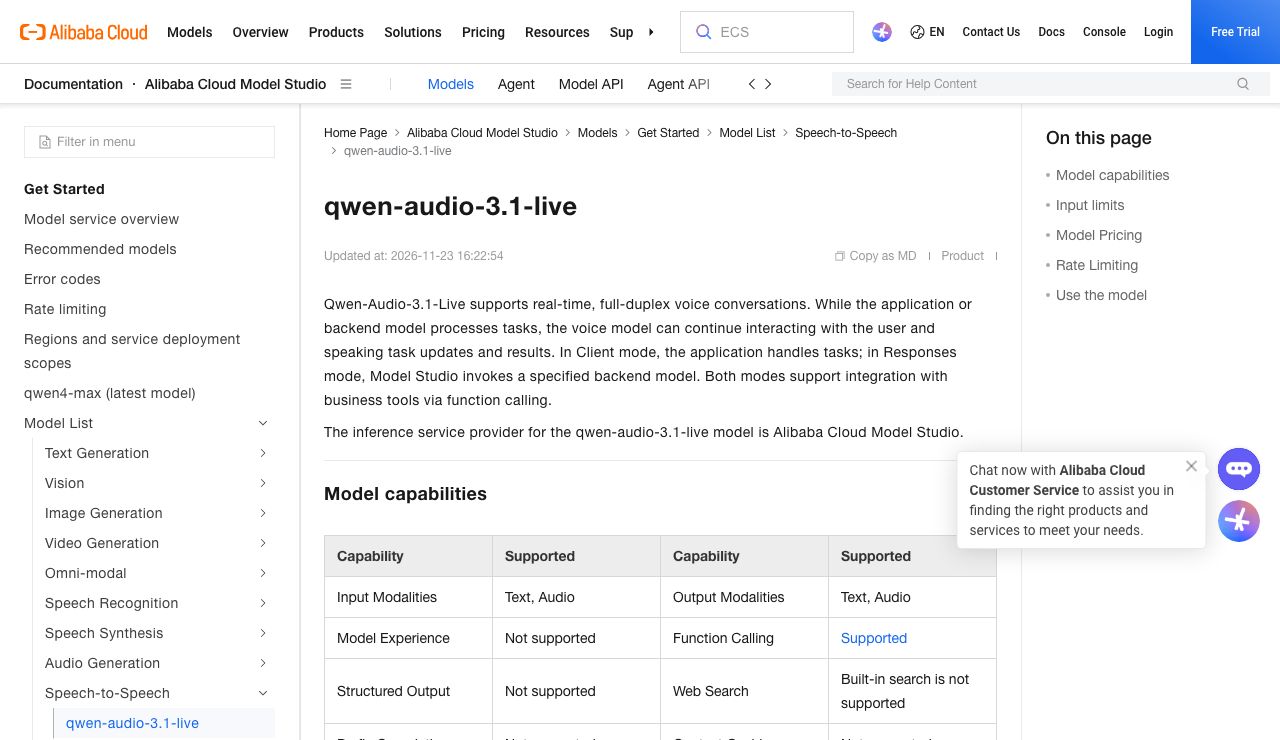
On November 23, 2026, Alibaba Cloud released "Qwen-Audio-3.1-Live," an AI model for real-time voice conversations, on its AI model service "Model Studio." Its defining feature is that while time-consuming tasks such as looking up orders or doing calculations are handed off to other programs or AI models in the background, the AI keeps talking with the user and then reports the results by voice once they arrive. Alibaba Cloud describes it as a model for building voice assistants and customer support that can use tools while talking. It is meant for developers to build into their own services through the API, not a new feature in a consumer app.
What it can do
Qwen-Audio-3.1-Live works in what is called "full-duplex" mode. Just as on a phone call, the AI can keep listening to the user even while it is speaking.
With earlier voice AI, if a user asked, for example, "When will my order from last week arrive?", the conversation tended to stall until the AI finished looking up the order. Qwen-Audio-3.1-Live separates the voice model that handles the conversation from the system that does work in the background. The voice model listens to the user and asks follow-up questions while the work is handed off to the background, and it reads out the results when they arrive. Alibaba Cloud's documentation gives examples such as looking up orders, checking inventory, changing travel plans, and calculating a total from unit prices and quantities.
Two ways to use it
You can choose between two ways of handing off work.
- Client mode: the developer's app calls its own business systems, workflows, AI agents or other tools to do the work and returns the results. The app also decides what to tell the user
- Responses mode: Model Studio calls a background AI model specified in advance. The documentation shows an example of handing calculations to "Qwen4-Max," the top-tier model released in November
The voice model can also call external functions directly. On the other hand, it does not support Web search, structured output, caching, batch processing or fine-tuning. The instructions and function settings passed to the voice model can total up to 65,536 tokens.
Pricing and availability
Pricing is based on conversation time, not on tokens used. According to Alibaba Cloud's model documentation, it costs $0.00071 per second in the Singapore region and $0.000471 per second in the China (Beijing) region. Talking continuously for an hour works out to about $2.56 in Singapore. Each connection is charged a minimum of 3 seconds, and silence, waiting time and text messages all count as conversation time. In Responses mode, usage of the background model is billed separately at that model's token rates.
Connections use WebSocket (a method in which the browser and server stay connected to exchange audio), with up to 5 connections open at the same time. In the list of new models, the international region is given as Singapore. The Tokyo region did not appear in the documentation we checked.
How it differs from earlier voice models
Alibaba launched its "Qwen-Audio-3.1" family of voice models in September (for the speech generation model presented at its September 22 tech event, see our article on the Qwen 4 roadmap), and Model Studio has added Plus (September 20) and Flash (October 27) versions of "Qwen-Audio-3.1-Realtime" for conversation. These can also hold full-duplex conversations and support calling external functions, Web search and voice cloning. What is new with Live is that it separates the voice model handling the conversation from the system doing work in the background, so the conversation can continue while work is in progress.
The documentation says the two Realtime models support 14 languages, including Japanese. The Live page, however, does not list supported languages, the number of voices or response speed, and we could not confirm whether it can be used in Japanese. The documentation also makes no mention of it becoming available in the Qwen chat app.
CoAI's take
OpenAI, Google and others also offer developer APIs for AI that can hold real-time voice conversations. What sets Qwen-Audio-3.1-Live apart is that it lets developers directly specify Alibaba's own top-tier model, Qwen4-Max, as the background worker. In situations such as phone support lines or reservation desks, where you want to look things up without keeping people waiting, it should help keep conversations from breaking off.
On the other hand, because it is billed by conversation time, silence is also charged. Japanese support and availability in the Tokyo region could not be confirmed from the documentation either, so if you plan to use it for services aimed at Japan, it is wise to test it in practice to check how well it understands and speaks Japanese, and to confirm where data is processed.
