Screenshots show the official pages on the capture date and may differ from the pages at publication. Select an image to enlarge it.
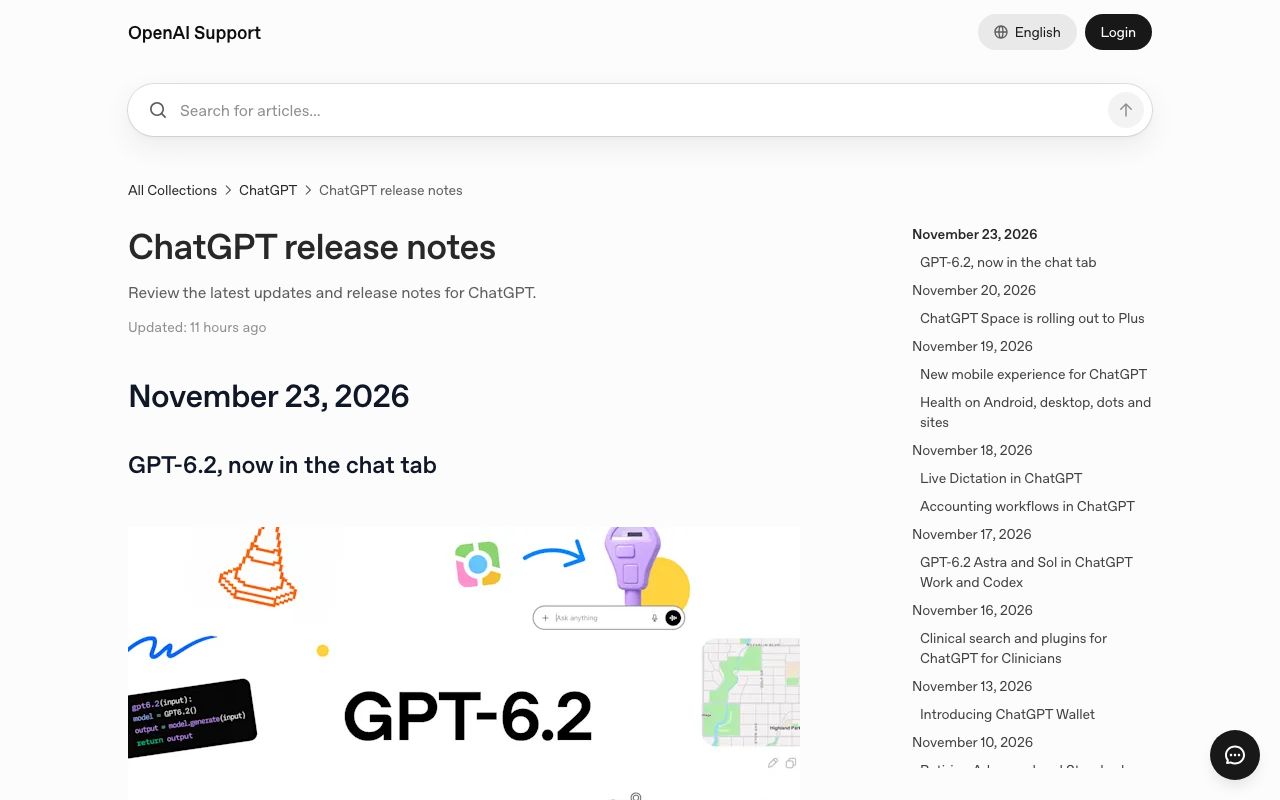
On November 23, 2026 (US time), OpenAI began switching the model behind ChatGPT's "Chat" interface to GPT-6.2. It is a version tuned for everyday conversation and is based on "GPT-6.2 Sol." It covers the Plus, Pro, Business and Enterprise plans and is rolling out gradually worldwide from the same day. The change was announced in ChatGPT's release notes.
How this differs from the November 17 announcement
On November 17, OpenAI released the new models "GPT-6.2 Astra" and "GPT-6.2 Sol" (CoAI article). At that time, they were available in ChatGPT only in "ChatGPT Work," built for work, and "Codex," and the regular chat interface people use for everyday conversations was not included.
With this update, GPT-6.2 is coming to that chat interface as well. Until now, it ran on "GPT-6," introduced on October 7. On paid plans, that was a model based on GPT-6 Sol (CoAI article).
OpenAI explains that this update applies only to the chat interface, and that the models used in Work and Codex are unchanged.
What has improved
According to OpenAI, GPT-6.2 is now better at handling requests with detailed instructions and requests that involve searching the Web. For example, when comparing hotels for a weekend trip, it can weigh conditions such as price and location and recommend options that match what the user wants. OpenAI also says it is better at noticing when it should keep helping later, such as offering to alert the user when a price drops after they ask whether something has gotten cheaper.
OpenAI shared the following comparisons with the previous GPT-6.
- Answering questions about shared images: 71.7% on an internal test in the chat (GPT-6: 47.4%)
- Share of especially difficult requests answered as instructed: 78.1% (GPT-6: 62.5%)
- Internal evaluation of expert-level tasks: 65% at the lowest thinking setting tested (GPT-6: 52%)
- Finding answers to hard questions online: on an internal version of "BrowseComp," it beat GPT-6 at all four thinking settings, scoring 64.5% at "Extra high" (GPT-6: 54.4%)
All of these figures come from OpenAI's own internal tests and have yet to be verified externally.
Safety improvements
OpenAI says results improved significantly on evaluations designed to protect teenage users. The biggest gains were in psychological dependence on AI, topics related to eating disorders, and age-restricted goods and services and dangerous activities. The share of difficult conversations in which it followed safety policies was 91–94%, up from 77–80% for GPT-6. Details are in the "GPT-6.2 in ChatGPT" system card (a document explaining safety), published the same day.
Eligible plans and the Free tier
This rollout covers the following.
- Eligible: the chat interface in ChatGPT Plus, Pro, Business and Enterprise
- Regions: gradually worldwide from the same day (some accounts will not switch right away)
- Enterprise: availability depends on administrator settings
The announcement does not list the Free and Go plans. In the October 7 announcement, OpenAI said that the chat interface on the Free and Go plans would use "GPT-6 Luna." It has not said when these plans will switch to GPT-6.2. The Edu plan is also not listed as eligible this time. The announcement also does not say whether users can switch back to the previous GPT-6.
CoAI's take
The November 17 announcement was about the work-focused interface and developer offerings. With this switch, many users on paid plans will get GPT-6.2's improvements directly in their everyday chats. The difference may be most noticeable when asking questions about photos or screenshots, or when doing research with many conditions.
On the other hand, users on the Free and Go plans are left out this time. The figures shared also come from OpenAI's internal tests, and no comparisons with other companies' models, such as Anthropic's Claude or Google's Gemini, have been published. For important research, it is still best to check sources as you go.