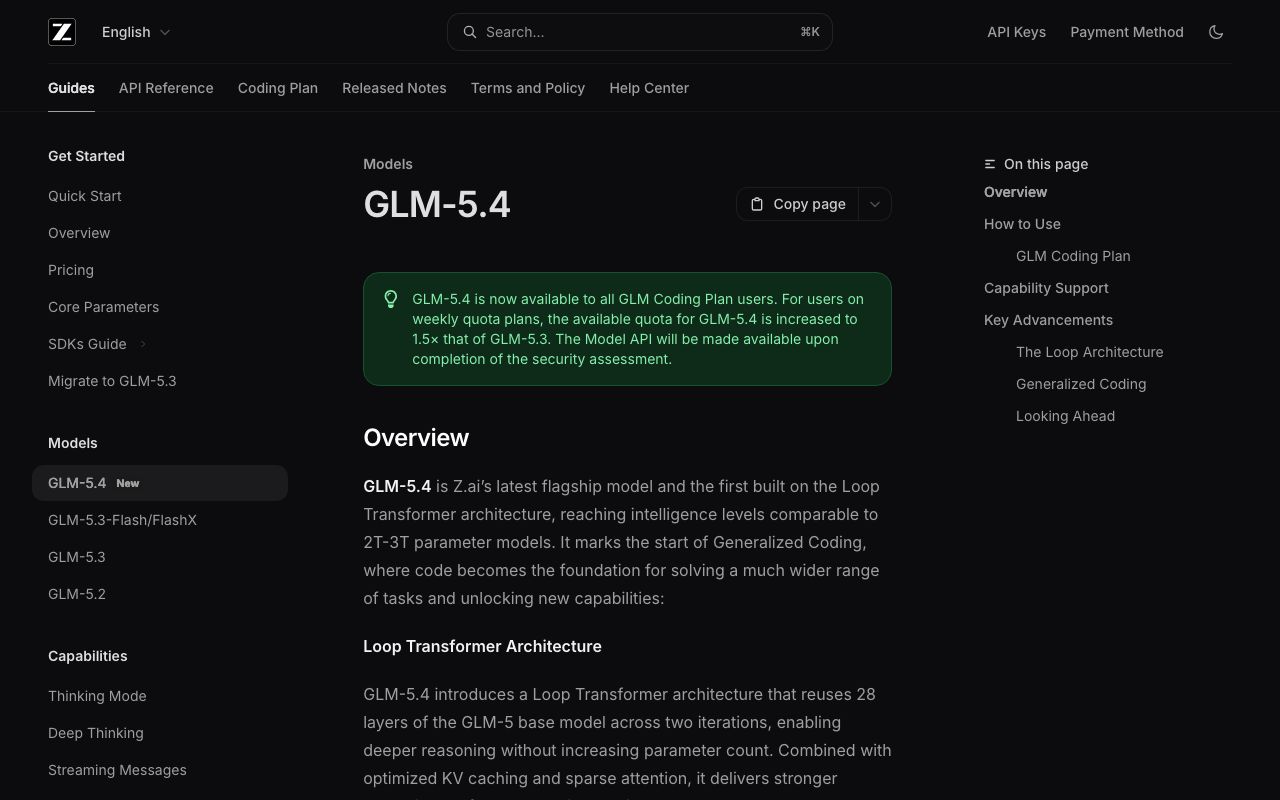
Screenshots show the official pages on the capture date and may differ from the pages at publication. Select an image to enlarge it.
The Chinese AI company Z.ai (Zhipu AI) has made its new flagship model "GLM-5.4" available on its flat-rate coding plan, the "GLM Coding Plan." The Chinese tech outlet TechNode reported the news on November 23, 2026. According to Z.ai's developer documentation, all tiers (Lite, Pro and Max) can use three models: GLM-5.4, GLM-5.3 and GLM-5.3-Flash.
What has changed with GLM-5.4
The previous flagship, GLM-5.3 (released in August), accepted text only. GLM-5.4 accepts images, video and files in addition to text. Its main specs are as follows.
- Input: video, images, text and files (output is text)
- Amount of text it can handle at once (context): 1 million tokens
- Maximum output per response: 128,000 tokens
- Supports a mode that thinks before answering, calling external tools, and output in fixed formats such as JSON
- Output speed: up to 200 tokens per second during off-peak hours, and 70–80 tokens per second during peak hours
The 1M-token context was already supported by GLM-5.3, and image input was already supported by GLM-5.3-Flash, the lightweight version released in August. GLM-5.4 brings both together in the flagship model.
Z.ai says GLM-5.4 is its first flagship model to use an architecture called "Loop Transformer." By passing some of the model's layers through twice, it can think more deeply without increasing the number of parameters (a figure indicating the model's size). Z.ai says that with a model of about 750 billion parameters, it has reached intelligence comparable to models with 2 trillion to 3 trillion parameters. It also says that by combining coding ability with image understanding, the model can be applied to video editing, game development, 3D modeling and mechanical design.
On the other hand, Z.ai also acknowledges a weakness: the model "tends to overthink and fall into long loops." Performance comparisons are shown in charts, but all of them are Z.ai's own evaluations.
Using it on the flat-rate plan, and credits
The GLM Coding Plan lets you use Z.ai's models for a flat fee from more than 20 coding tools, including Claude Code, Codex and OpenCode. Pricing starts at $18 a month, and each tier has a set number of credits (usage allowance) per 5 hours and per week.
- Lite: 2,000 credits per 5 hours, 10,000 per week
- Pro: 12,000 credits per 5 hours, 60,000 per week
- Max: 28,000 credits per 5 hours, 140,000 per week
GLM-5.4 uses about two-thirds the credits of GLM-5.3. The per-token consumption multipliers are 4.6 for input and 16 for output with GLM-5.4, and 6.9 for input and 24 for output with GLM-5.3. As a result, you can use 1.5 times as much GLM-5.4 as GLM-5.3 within the weekly allowance. Credit consumption is halved during off-peak hours; peak hours are 14:00–18:00 Singapore time on weekdays (15:00–19:00 Japan time).
To use it in Claude Code with the 1M-token context, change the model name to "glm-5.4[1m]" in the settings file (settings.json) and also adjust the auto-compaction setting (CLAUDE_CODE_AUTO_COMPACT_WINDOW) as described in the official instructions.
The API and weights are not yet available
Z.ai says a general-purpose API for GLM-5.4 will be released "after safety evaluations are complete." For now, the model can only be used within the GLM Coding Plan.
The model weights (the model's underlying data) were also not published on Z.ai's Hugging Face page as of November 24. The weights for GLM-5.3 and GLM-5.3-Flash are published on the same page. The developer documentation explains the architecture, but TechNode reports that a technical report detailing evaluation results and other information has not yet been released.
CoAI's take
Z.ai only just released "GLM-Legal," built on GLM-5.3-Flash for legal work, in October. This time it has replaced its flagship model, letting users try image-aware coding directly from tools such as Claude Code. Because it uses fewer credits than GLM-5.3, the change lets flat-rate plan users do more for the same price. Its approach of improving performance with an architecture that "thinks repeatedly" rather than by adding parameters also stands out as a different path from the one other developers are taking.
The international version, z.ai, can be paid for in US dollars, and the regions its terms of use list as unsupported include Iran, North Korea, Cuba and Crimea; Japan is not among them. However, the terms state that individual users' inputs may be used to improve the service. If you will be working with business code, check how data is handled. Performance figures are Z.ai's own evaluations and have yet to be verified externally.
