Screenshots show the official pages on the capture date and may differ from the pages at publication. Select an image to enlarge it.
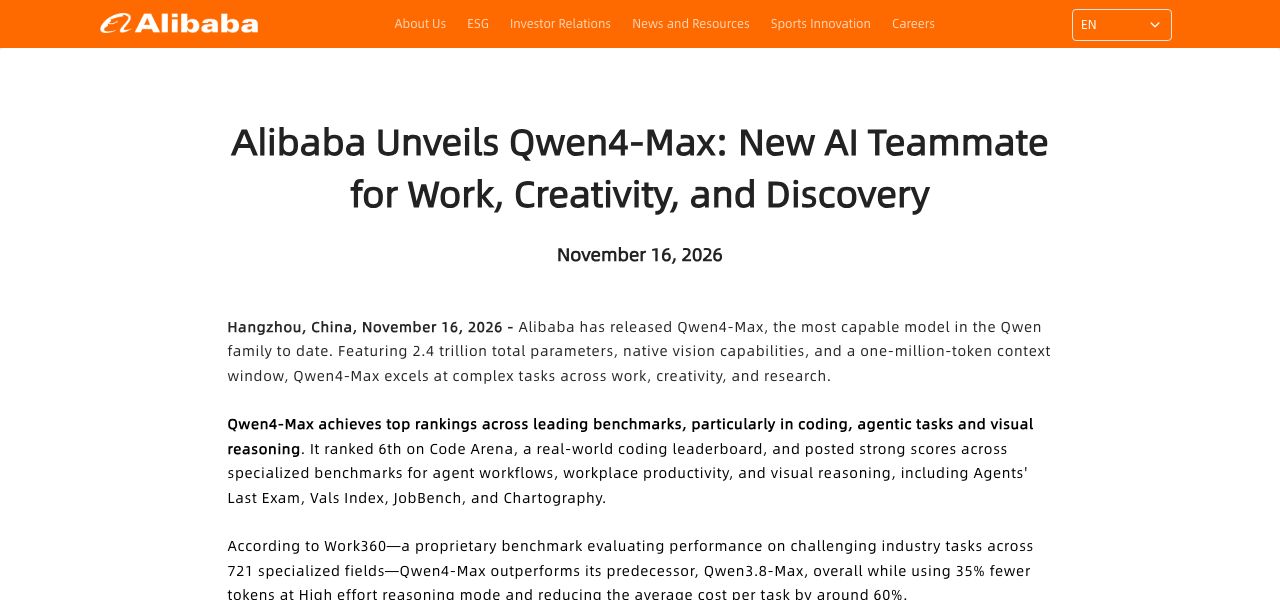
On November 16, 2026, Alibaba officially released "Qwen4-Max," the top model in its next-generation "Qwen4" AI series. It follows "Qwen4-Max-Preview," a trial version released for a limited time on November 11, and Alibaba positions it as an "AI teammate" that supports work, creativity and research. It is available through Alibaba Cloud's model service (QwenCloud / Model Studio) via the API or the monthly Token Plan.
Qwen4-Max specs
According to Alibaba's announcement and Alibaba Cloud's developer documentation, the main specs are as follows.
- 2.4 trillion total parameters. It uses MoE (a design that activates only some of its "experts" for each query), with 71 billion parameters active per token, 25% fewer than the previous top model, Qwen3.8-Max
- A context window of 1M tokens
- It can take images and video as input in addition to text (output is text only)
- Thinking before answering is on by default, with three thinking levels to choose from (low, high and xhigh)
- Supports calling external tools, Web search and output in a fixed format (JSON)
- Can be called using the same formats as the OpenAI and Anthropic APIs
A single response can be up to 131,072 tokens, or up to 262,144 tokens when thinking is used.
Performance
According to Alibaba, Qwen4-Max ranked sixth on Code Arena, an evaluation site where people compare models on real programming tasks. Alibaba says it also scored highly on evaluations of AI agent tasks and chart reading.
On Work360, Alibaba's own evaluation of work tasks, Alibaba says Qwen4-Max outperformed Qwen3.8-Max overall while using 35% fewer tokens and cutting the cost per task by about 60%. It also shared examples such as cutting the time needed to create machining programs for parts at an automotive plant from about 475 minutes to 24 minutes, and having the model work continuously for 48 hours on tasks such as designing new molecules. All of these come from Alibaba itself and have yet to be independently verified.
Pricing and availability
According to Alibaba Cloud's pricing page, API pricing per 1M tokens in the Singapore region is $1.5 for input, $4.5 for output and $0.075 for input that hits the cache (reuse of previously loaded input). In regions such as Tokyo, Hong Kong and Frankfurt, it is $1.413 for input and $4.24 for output. In Singapore, there is a free quota of 1M tokens, valid for 90 days from when you start using the service.
It is also available in the following ways.
- The monthly "Token Plan": four individual plans ranging from Lite at $6 a month to Pro at $43 a month, all supporting Qwen4-Max (individual plans are offered only in Singapore)
- QwenWork, an AI tool for work, and QwenStudio for developers
The weights of Qwen4-Max itself have not been released. Alibaba says it will soon release smaller models in the Qwen4 series as open weights (a form anyone can download and run) for developers around the world.
How it differs from the Preview version
The Preview version released on November 11 can be used only through the Token Plan, only via conversations in programming tools, and only until midnight China time at the end of November 25 (1:00 a.m. on November 26, Japan time). Its model size and evaluation scores were not disclosed.
The official version can also be used through the regular pay-as-you-go API, with a choice of several regions, including Tokyo. The parameter count and evaluation results have also been published. In its Preview documentation, Alibaba Cloud recommends using the official version. On the Token Plan, the usage discount that applied to the Preview version does not apply to the official version.
CoAI's take
The official version comes with pay-as-you-go pricing, which the Preview lacked, so it can now be built into business workflows without worrying about a trial period. The option to choose a Tokyo region, and the fact that it can be called in the same formats as Anthropic and OpenAI, making it easy to plug into existing developer tools, also make it easy for developers in Japan to try.
On the other hand, although Qwen has released many of its models with their weights, the top-tier Max is API-only. Most of the performance figures come from Alibaba's own evaluations. If you want to run it locally, keep an eye on the release timing and license of the smaller open-weight versions said to be coming soon. For business use, also check where data is processed and the terms of service.
