Screenshots show the official pages on the capture date and may differ from the pages at publication. Select an image to enlarge it.
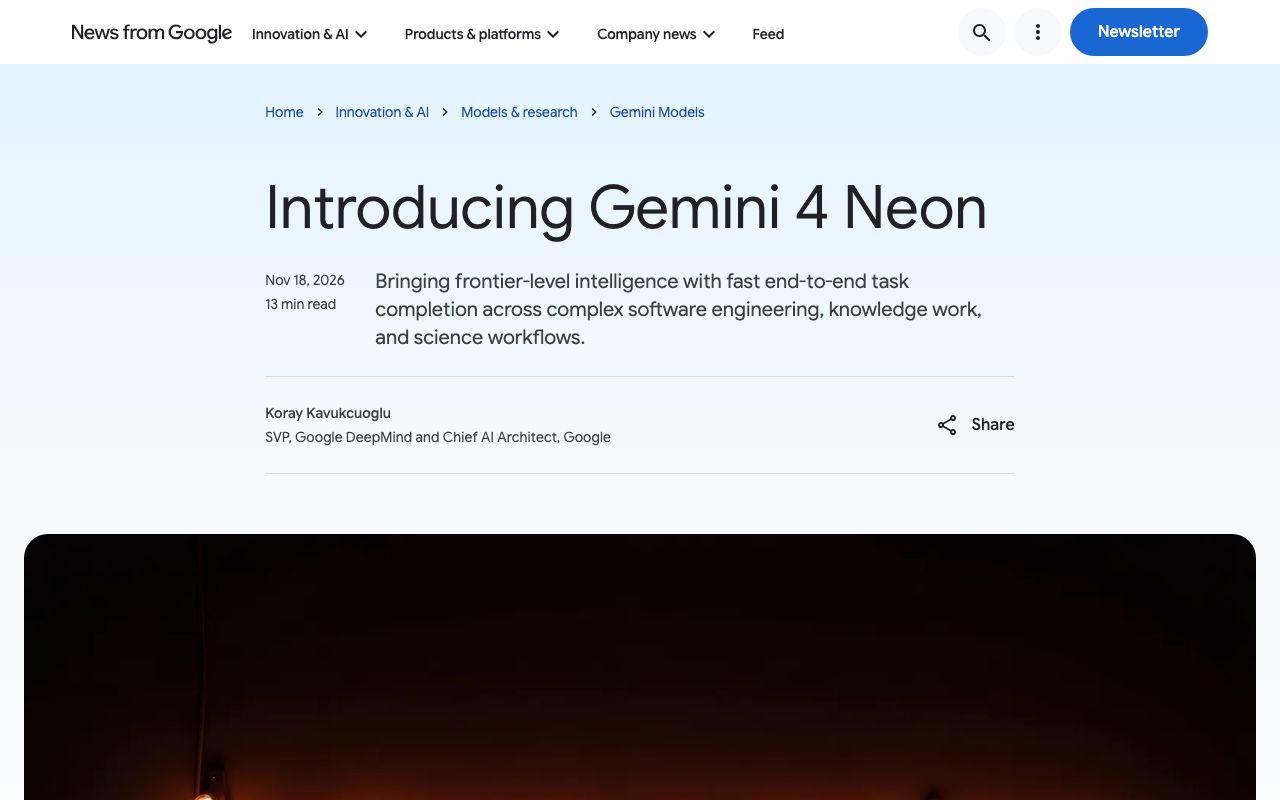
On November 18, 2026 (US time), Google released a new AI model, "Gemini 4 Neon." It sits between "Gemini 4 Carbon," built for the hardest long-running work, and "Gemini 4 Hydrogen," which handles everyday tasks quickly, and balances depth of thinking with efficiency. Its main uses are complex programming, analytical reasoning and automating production business workflows at companies. It became available in the Gemini API as a stable version (generally available) on launch day, and also began rolling out in GitHub Copilot the same day.
Neon's place in the Gemini 4 family
Google has so far released Argon, Carbon and Hydrogen in the Gemini 4 lineup. Google describes Neon as follows.
- Carbon: for the hardest, most time-consuming projects
- Neon: balances depth and efficiency, for complex coding and business automation
- Hydrogen: handles everyday tasks quickly
According to Google, Neon's cost per task with the standard settings is 32% lower than Carbon's. GitHub, citing Google, also says Neon delivers quality close to Carbon's at a lower token cost, starts responding faster and is less likely to make changes it was not asked to make. Google's announcement does not compare Neon's performance with Argon's, nor does it say that Neon replaces Argon or any other existing model.
First place on a coding agent index
The main results Google reported are as follows.
- First overall with 58.6 points on the Coding Agent Index from the third-party firm Artificial Analysis, which measures coding ability as an AI agent
- Third with 61 points on Artificial Analysis's overall Intelligence Index, using the deepest thinking setting
- 65.2% on an evaluation of solving tasks through commands (Terminal-Bench 4.1)
- First on agent evaluations for legal research (Legal Research Bench) and tax work (Tax Agent Bench)
Google says that with the deepest thinking setting, its cost per task is at least 36% lower than competing models from other companies. All of these figures are based on Google's announcement, and for the coding agent index, it does not name the other companies' models it compared against.
API pricing and specs
The model ID in the Gemini API is "gemini-4-neon." It is available only on paid plans, with no free tier.
- Pricing is $3 per 1M input tokens and $15 per 1M output tokens (including thinking tokens)
- Repeated identical input is automatically discounted, and that portion costs $0.15 per 1M tokens (95% off)
- The context window is about 1M tokens
- Thinking depth has four levels, "low," "medium," "high" and "xhigh." The default is high
That puts it between the regular price that Carbon and Argon will charge from December ($4 input, $20 output) and Hydrogen ($1.5 input, $7.5 output). However, Carbon and Argon are offered at an introductory price of $2 input and $10 output until November 30, so Neon costs more than they do through the end of November.
It does not support generation settings such as temperature, or caches that developers create explicitly. Google says developers can migrate from Carbon, Argon or Hydrogen just by changing the model ID.
Availability in the Gemini app, Antigravity and GitHub Copilot
From launch day, Neon is available in the following places.
- Gemini app: Google AI Pro and Ultra subscribers can choose Neon from the model options
- Developer tools: Google AI Studio, Android Studio, and Google Antigravity for paid Google AI Pro and Ultra subscribers
- For businesses: Gemini for business (API and model choices)
- Fairwind Program, a vetted-access framework for cyber defense organizations
In GitHub Copilot, Pro+, Max, Business and Enterprise subscribers can use it. It is rolling out gradually in VS Code, Visual Studio, JetBrains IDEs, Xcode, Eclipse, Copilot CLI, github.com, GitHub Mobile and more, with usage-based billing based on Google's list prices. On Business and Enterprise, it is enabled automatically unless an administrator turns it off.
Google has not said anything specific about availability in Japan or about the Japanese language.
CoAI's take
Neon is a practical mid-tier model that comes close to Carbon's performance while keeping costs down. In the Gemini app, the top-tier Carbon is limited to AI Ultra subscribers, while Neon can also be chosen by AI Pro subscribers, which opens an advanced model to more people.
On the other hand, its API price is higher than Carbon's and Argon's introductory prices through the end of November, so which model is the better deal depends on timing and use case. Gemini 4 now has four models. For development work, the realistic approach is to compare success rates and cost per task on the same problems and choose a model based on how hard the work is. GitHub Copilot users can try it right away in their usual development environment.