Screenshots show the official pages on the capture date and may differ from the pages at publication. Select an image to enlarge it.
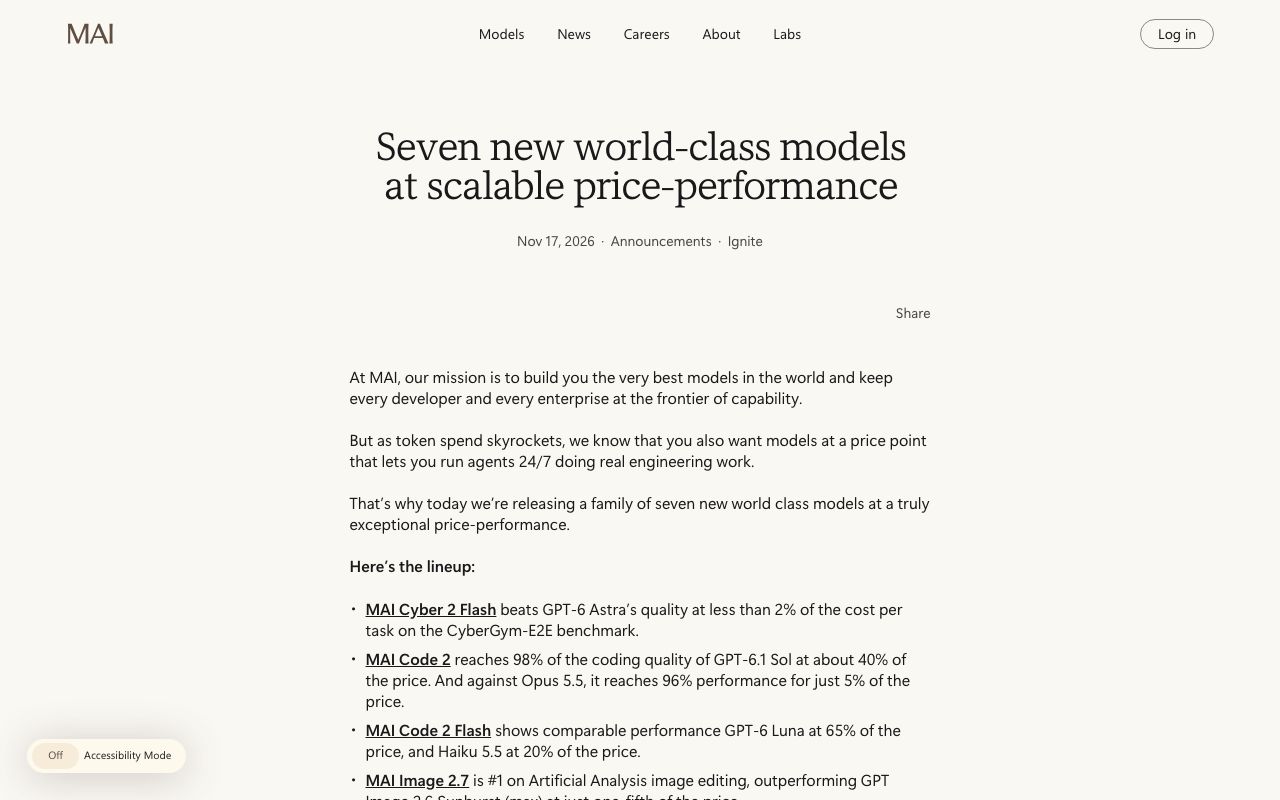
On November 17, 2026 (US time), Microsoft announced seven in-house AI models at once at "Ignite 2026," its annual event for developers and IT professionals. Most belong to the "MAI" (Microsoft AI) series and are split by purpose, covering coding, security, image editing and generation, voice conversations, transcription and routing work. Microsoft put "price-performance" front and center, emphasizing that the models are cheaper to use than those from OpenAI and Anthropic.
MAI Code 2 and Code 2 Flash for coding
MAI Code 2 is a coding model designed for enterprise development work. Microsoft says it delivers 98% of the coding quality of OpenAI's GPT-6.1 Sol at about 40% of the price, and 96% of the performance of Anthropic's Claude Opus 5.5 at 5% of the price. It has also been tuned for building dashboards and charts.
The lightweight MAI Code 2 Flash is built for high-frequency tasks such as explaining code, making partial edits and fixing common bugs.
- MAI Code 2: available on GitHub Copilot Pro, Pro+, Max, Business and Enterprise
- MAI Code 2 Flash: available on GitHub Copilot Free, Student, Pro, Pro+, Max, Business and Enterprise. A limited preview has also started in Microsoft Foundry (Microsoft's enterprise AI development platform)
- Both can be selected as models in Visual Studio Code, Visual Studio, Copilot CLI, github.com, JetBrains, Xcode and more, with usage-based billing
GitHub says that on Business and Enterprise, new models are enabled automatically unless an administrator has turned them off.
Models for images, voice and business tasks
- MAI Image 2.7 / 2.7 Flash: models for generating and editing images. Microsoft says MAI Image 2.7 ranked first for image editing on the evaluation site Artificial Analysis, beating OpenAI's GPT Image 2.6 Sunburst at one-fifth of the price. The Flash version costs about $10 per 1,000 images. Both are offered in Microsoft Foundry. MAI Image 2.7 had been trialed in late October as a preview limited to image editing, and it is now available to developers with image generation included.
- MAI Realtime 1: a low-latency conversation model that responds by voice when you speak to it. Microsoft says it outperformed OpenAI's GPT-Realtime 2.1 in external evaluations, with pricing starting at $0.01 per minute of audio. For now it can be tried in the "MAI Labs" testing space, and Microsoft is taking advance sign-ups for full access.
- MAI Transcribe 2: a multilingual transcription model. It powers "Dragon Copilot Transcribe," which records conversations between doctors and patients in the healthcare product "Dragon Copilot."
- MAI Cyber 2 Flash: a security model that finds weaknesses (vulnerabilities) in software. It is used in MDASH, Microsoft's security testing system, and its output pricing is 86% lower than that of the previous MAI Cyber 1.1 Flash.
- Decision 1.1 (officially named Microsoft-Decision-1.1): a model that quickly and cheaply makes decisions such as routing inquiries, classifying them and setting priorities. It is designed so that only difficult work is passed on to larger models. It became generally available on November 17 and can be used in Microsoft Foundry as well as on OpenRouter and Vercel.
Microsoft also announced MAI Licensed Weights, which let companies fine-tune MAI models on their own data and run them in their own Azure environments. A key feature is that companies keep control of their data and fine-tuned models, and according to media reports, it will be offered through Microsoft's partner programs in the future.
Parts of the Copilot app are now generally available
There were also updates on the new Copilot experiences announced in September (Home, Code and Autopilot). Home and Office in Copilot are now generally available, and Code is scheduled to launch in the coming weeks. Autopilot has started rolling out to companies in the early-access "Frontier" program. In Copilot, in addition to "Auto," which automatically picks a model to suit the task, users can also choose models from OpenAI and Anthropic.
CoAI's take
Microsoft has relied heavily on OpenAI's models until now, but with this announcement it has lined up in-house models for major use cases such as coding, images and voice. The benchmark comparisons come from Microsoft itself, and results vary depending on conditions. Still, because even GitHub Copilot's Free plan can select MAI Code 2 Flash, it is easy to use it for everyday code fixes and compare it with other companies' models.
MAI Image 2.7 for images and Decision 1.1 for decision-making are mainly aimed at developers using Microsoft Foundry, so everyday users still have few chances to try them right away. The announcement does not specify availability in Japan or Japanese-language support.
Sources
- Seven new world-class models at scalable price-performance (Microsoft AI)
- Copilot at Microsoft Ignite: Expanding what's possible with intelligence built for work (Microsoft)
- MAI Code 2 and MAI Code 2 Flash in GitHub Copilot (GitHub)
- Microsoft-Decision-1.1 general availability (Microsoft)
- MAI-Image-2.7 (Microsoft Foundry)
- Ignite 2026: Microsoft AI Announces 7 New Models (Thurrott.com)
- MAI Image 2.7 reaches the image-editing top tier, but Microsoft has not priced the preview (Magica)