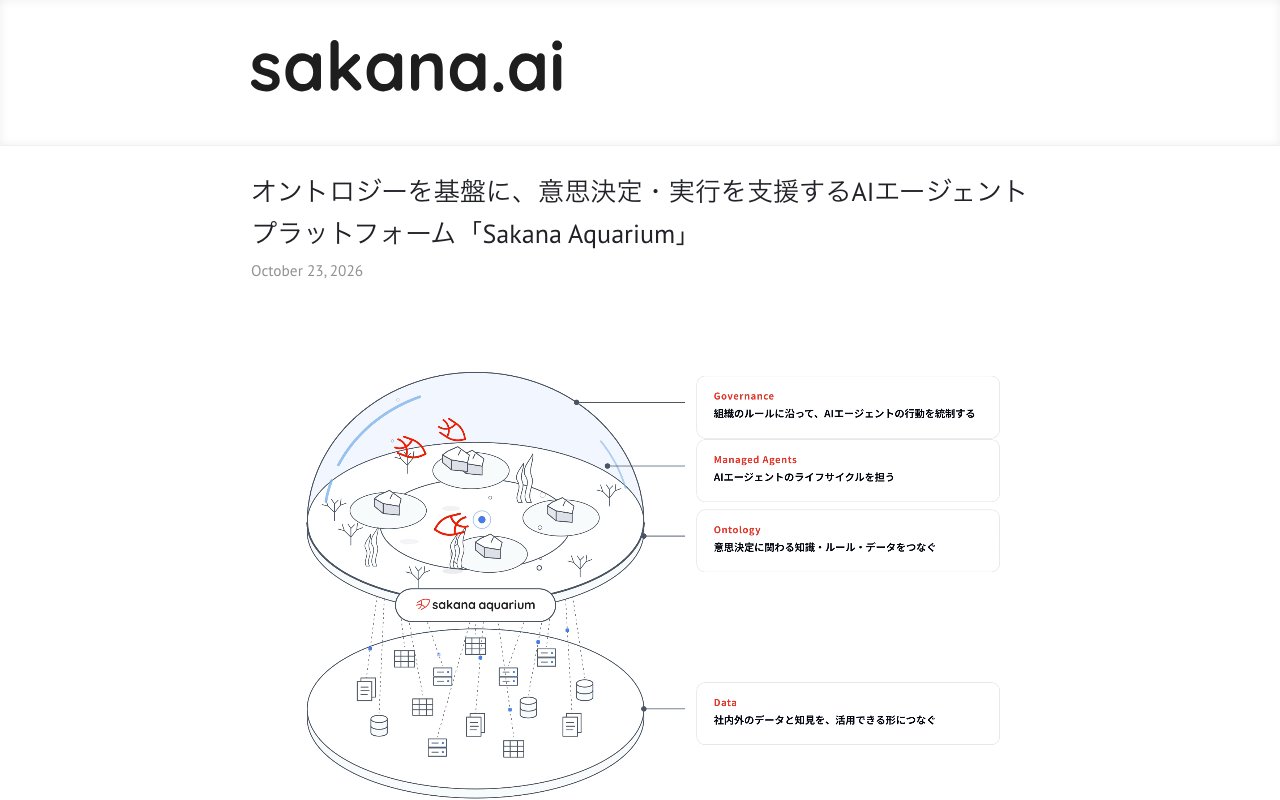
Screenshots show the official pages on the capture date and may differ from the pages at publication. Select an image to enlarge it.
On October 23, 2026, Tokyo-based AI company Sakana AI announced Sakana Aquarium, an AI agent platform for enterprises. It first organizes the decision criteria and rules, which differ from one organization to the next, into a form AI can work with, and then lets companies build, run and operate AI agents (AI that carries out work on its own) on top of that. Sakana AI built it based on experience gained through work with MUFG Bank, SMBC Group and Daiwa Securities Group.
What Sakana Aquarium is
Sakana AI describes Sakana Aquarium as "a platform for building, running and operating AI agents that supports an organization's decision-making and its execution, built on an ontology."
Inside a company, the information used to make decisions, such as spreadsheets, documents, system data and internal rules, is scattered across many places. What criteria are used and how decisions are made also differ by organization. Sakana Aquarium aims to organize this information and these decision criteria in one place so that AI agents can act on the right grounds.
The name compares the platform to many fish swimming in a single tank in a well-maintained environment. It expresses the idea that data connections and decision criteria, once organized, can be reused by multiple agents.
Three pillars
Sakana Aquarium is made up of three parts:
- Ontology: systematizes the knowledge, rules and data behind an organization's decisions, together with their meanings and relationships. Data does not need to be moved from where it is currently stored, and updates to the original data are reflected
- Governance: controls data, the ontology and agents. It can set access permissions and steps that require human approval before execution, and records everything from the grounds for a decision to the results of execution. It also shows execution speed and accuracy, as well as AI model usage
- Managed Agents: agents can be run simply by writing information lookups, AI judgments, function calls and human approvals as a workflow. According to the product page, workflows are written in YAML, a configuration file format. Management after deployment is also handled in one place
Ontology originally means "a system that organizes the meanings of things and their relationships." In data analytics, US company Palantir and others have popularized it as a way of organizing enterprise data.
Built on work with financial institutions
Sakana AI has been working with client companies in the financial sector to embed AI in real business operations. With MUFG Bank it has worked on "AI Lending Expert" to support lending operations, with SMBC Group on a system that automatically creates proposal documents, and it is also co-developing with Daiwa Securities Group.
In these projects, engineers who go into clients' sites to build (FDE, Forward Deployed Engineers) have built systems on a project-by-project basis. Sakana Aquarium packages the parts that were needed again and again into a common platform. Sakana AI says that, in addition to its own engineers, people who built data platforms at Palantir, Snowflake, Microsoft and AWS have joined the development.
Future plans
Sakana AI says it will expand the platform's capabilities. Specifically, it is developing the following two mechanisms:
- A mechanism that takes in corrections and decisions made during operation and keeps updating the ontology and agents
- A mechanism in which AI assists with the work of building AI agents itself
Use cases will be introduced over time.
Pricing and availability
Pricing and the timing of general availability, when anyone could sign up, have not been disclosed. The announcement also does not say how it will be offered, such as which AI models it uses or whether it runs as a cloud service or is installed on a company's own servers. The product page says the company accepts adoption inquiries according to each client's challenges and business requirements, so for now it starts with an inquiry.
CoAI's take
To use AI agents seriously in business, it is not enough for the AI to be smart. Being able to check afterwards what a decision was based on and who approved it is essential. In heavily regulated industries such as finance, this tends to be a barrier to adoption. The fact that Sakana Aquarium puts organizing decision criteria and managing approvals and records front and center reflects its hands-on experience with major Japanese financial institutions.
On the other hand, pricing, the delivery model and case studies showing performance have not yet been published. Overseas, Palantir and the major cloud providers offer similar platforms, and whether this gives Japanese companies a reason to choose it will have to be judged from the case studies released going forward. If you are considering it, it is worth confirming at the inquiry stage where your company's data can stay while being used, and which AI models are used.