Screenshots show the official pages on the capture date and may differ from the pages at publication. Select an image to enlarge it.
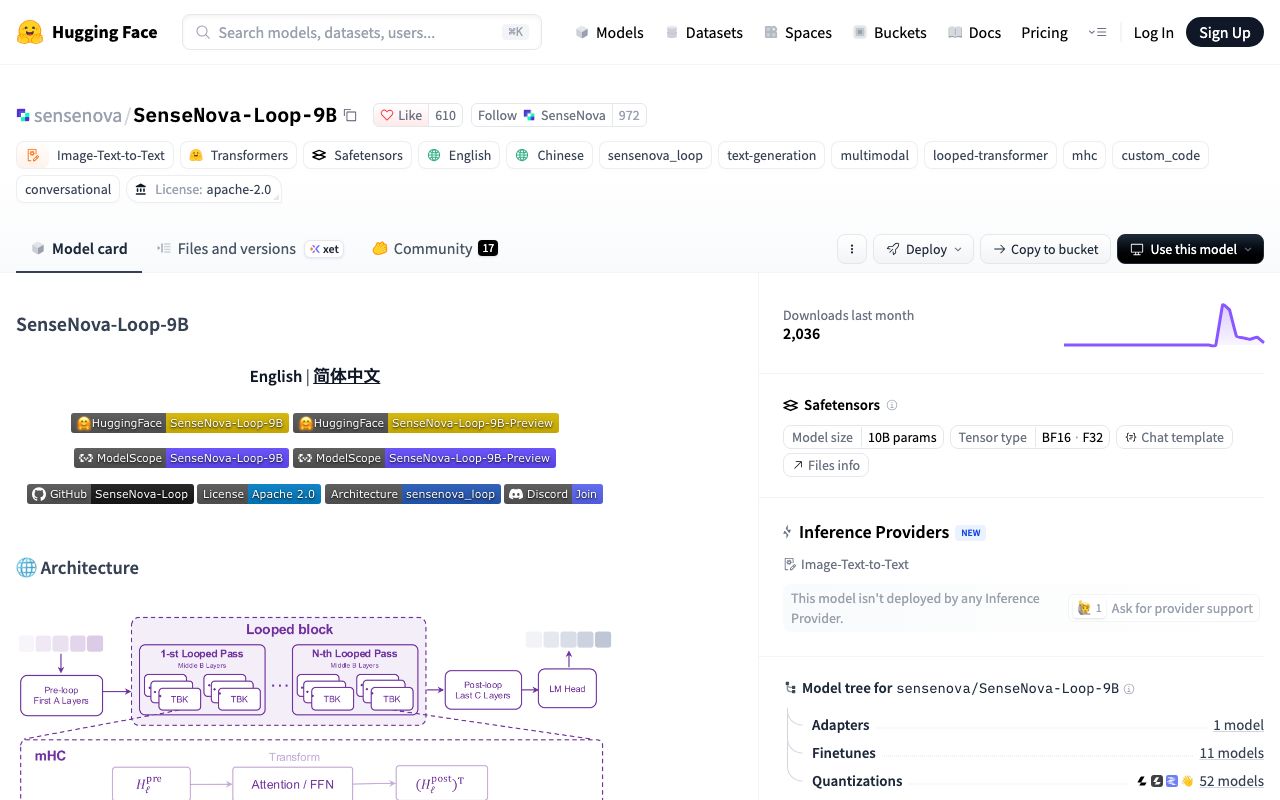
On November 17, 2026, Chinese AI company SenseTime released the official version of its open model "SenseNova-Loop-9B." It follows a preview version released at the end of October. With about 9 billion (9B) parameters, it is on the small side, but what makes it stand out is a "looped" design that runs the same part of the model twice to increase the depth of computation. The model weights (the data that makes up the model) and code are released under the Apache 2.0 license and can be downloaded from Hugging Face and ModelScope.
What is a looped design?
AI models are built from dozens of stacked computation stages called "layers." Input text is processed in order starting from the first layer, and understanding deepens with each layer it passes through. In a typical model, adding more layers tends to make it smarter, but each layer needs its own data (weights), so the model's size and memory needs grow too.
SenseNova-Loop-9B has 32 layers and runs the middle 24 layers (layers 5 to 28) twice in a row. After passing through the first 4 layers, the input goes through the middle 24 layers, the result is passed through those same 24 layers again, and then it moves on to the final 4 layers. Only 32 layers' worth of weights are stored, but the actual computation covers 56 layers. SenseTime says that in terms of computation, this is equivalent to a model with about 14.6 billion parameters.
The benefit for users is that the model can think more deeply without using more memory. The memory needed to run a model is determined mainly by the size of its weights, so it can do processing close to that of a larger model with the memory of a 9B model. The trade-off is that passing through the layers twice takes more computation time.
In SenseTime's experiments, varying the number of loops from one to four showed that scores were highest with three or four loops on many evaluations. However, to balance this against speed, the official version uses two passes. SenseTime says it also plans to research a mechanism that automatically adjusts the number of loops based on how hard a problem is.
Key specs
- Parameters: about 9 billion (equivalent in computation to about 14.6 billion)
- Input and output: accepts text and images as input and answers in text
- Context window: up to 512K tokens
- A "thinking mode" that thinks before answering can be turned on or off
- The supported languages listed are English and Chinese
- License: Apache 2.0 (commercial use allowed)
Runs with little memory
Compressed (quantized) to 4 bits, the weights come to about 4.9 GB. SenseTime gives the following estimates of the GPU memory needed to run it (with the KV cache, which serves as the conversation's memory, compressed to 8 bits).
- Up to 64K tokens: about 10 GiB
- Up to 128K tokens: about 12 GiB
- Up to 256K tokens: about 15 GiB
With the KV cache at 4 bits, each figure drops by about 1 to 3 GiB. On November 18, SenseTime added a 4-bit AWQ version and versions in GGUF, a format commonly used to run models on personal computers (BF16, Q8_0, Q5_K_M and Q4_K_M). Running the GGUF versions requires a version of llama.cpp modified by SenseTime. On November 20, it also released "DFlash2," a helper model for generating answers faster. In SenseTime's measurements, it increased the number of tokens generated per second by about 2.1 times when handling one request at a time.
Performance
SenseTime compares the model with the preview version and with Qwen3.8-27B, which has about 27 billion parameters, on evaluations of agent tasks, coding and data analysis. All of these are SenseTime's own evaluations.
- AutomationBench, which measures task automation: 36.67 (preview version 14.33, Qwen3.8-27B also 36.67)
- AIDABench, which measures data analysis: 65.31 (Qwen3.8-27B 65.01)
- NL2Repo, which measures the ability to write code for an entire repository: 41.36 (Qwen3.8-27B 44.60)
- Terminal-Bench 2.1, which measures command-line tasks: 59.55 (preview version 40.45)
- GAIA, which measures research and tool-use tasks: 69.90 (preview version 37.86)
- BIRD, which measures turning text into database queries: 72.34 (preview version 71.38)
SenseTime also lists weaknesses: the model can miss instructions when given many tools or conditions at once, it is not yet stable on long, complex tasks, and 3D or highly animated Web pages may not come out right on the first try, sometimes needing two or three rounds of revisions.
CoAI's take
Until now, the main way to improve AI model performance has been to add more parameters. SenseNova-Loop-9B tries a different direction: increasing how much the model thinks without making it bigger, by reusing the same layers. For people who want to run models on their own GPUs or smaller servers, its appeal is that it can deliver strong performance even with limited memory. While SenseTime's "SenseNova 6.8 Flash," released on November 2, is a large model used through services and the API, Loop-9B is positioned as a small open model for running in your own environment.
However, the performance figures come from SenseTime's own evaluations, and the only model it was compared against is Qwen3.8-27B. Japanese is not listed among the supported languages, so how well it works in Japanese will need to be tested. Also note that running it on common inference frameworks such as vLLM and SGLang requires builds with support that has not yet been officially merged, so it cannot yet be set up quickly and easily.