Screenshots show the official pages on the capture date and may differ from the pages at publication. Select an image to enlarge it.
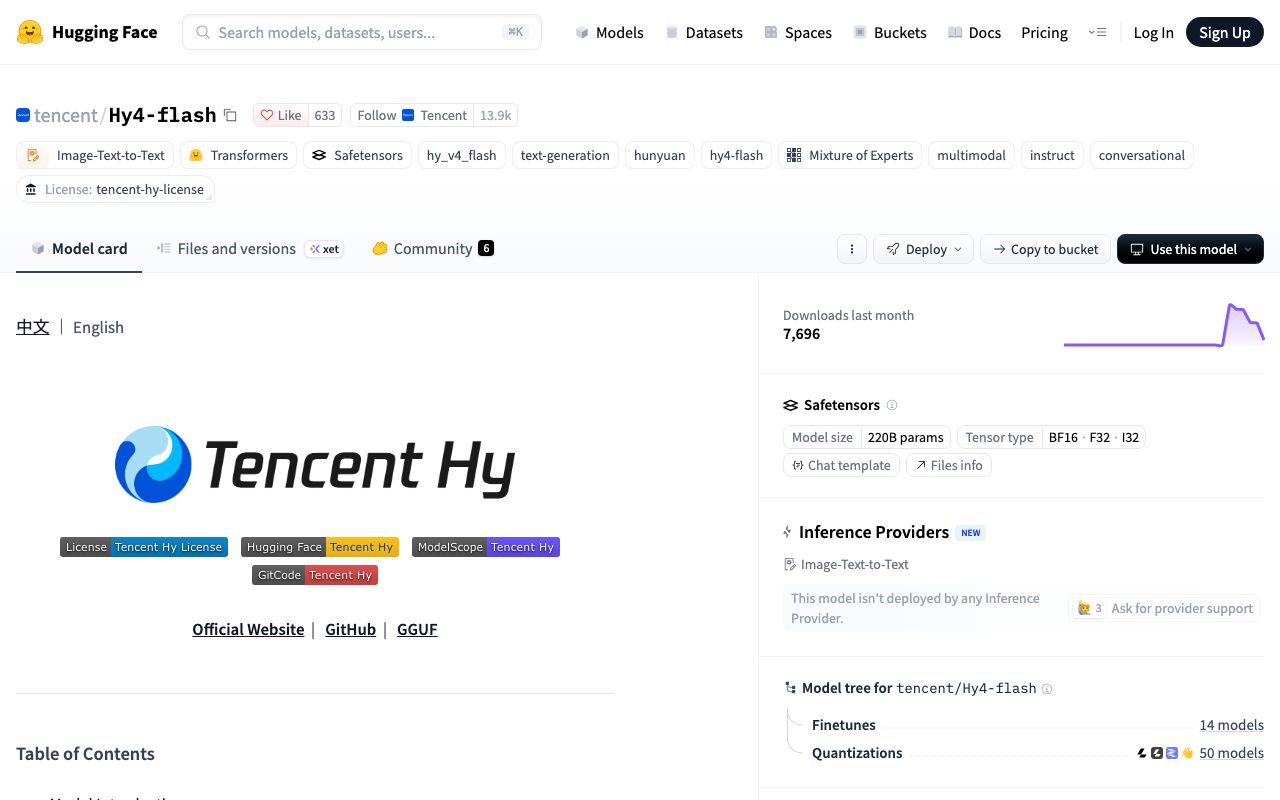
On November 17, 2026, Chinese tech giant Tencent released the AI model "Hy4 flash." It is a smaller, cheaper version of "Hy4," whose official version came out on November 4, and it is the model Tencent previewed when it announced Hy4. Tencent calls it "our most cost-efficient Hy model yet." Besides being available through the API and Tencent's own services, its model weights (the data that makes up the model) have also been released on Hugging Face and other platforms.
Smaller, cheaper and faster
Hy4 flash uses MoE (mixture of experts), a design that activates only some of its many "expert" components. Its main features are as follows.
- Size: about 220 billion total parameters according to the model card (about 224 billion in the announcement), with about 12 billion active per token
- Input: reads text and images and answers in text
- Context window: 1M tokens
- Speed: generates text at more than 150 tokens per second
It is much smaller than Hy4 (about 770 billion total parameters in the preview version released in August), and Tencent says it also cut the memory used to keep track of text to one-sixth of Hy4's. Tencent also credits the lower cost to training that built on what it learned from Hy4 and taught the model to keep its answers about half as long on average.
Performance and cost
Tencent compares the models on WorkIndex, its own evaluation based on common tasks in its AI agent product WorkBuddy (such as creating slides, editing documents and fixing spreadsheets). All of these are Tencent's own evaluations.
- WorkIndex score: Hy4 flash scored 42.1, slightly above the Hy4 preview version (39.7) but below Hy4 (51.4)
- Average cost per task: one-thirteenth that of the Hy4 preview version, one-twentieth that of Hy4 and one-eighth that of DeepSeek-V4.1-Flash-1017
- Comparison by 85 internal users: a satisfaction score of 2.79 out of 4, close to Claude Haiku 5.5 (2.81), at a cost of about 0.26 yuan per task
Tencent recommends Hy4 flash for everyday tasks such as research, document processing, creating slides, quick prototyping of simple Web pages and operating computers, and Hy4 for long-running work such as software development.
Pricing and availability
API pricing per 1M tokens is about $0.070 for input, about $0.281 for output and about $0.003 for cached input. Hy4 flash is available in the following Tencent services.
- TokenHub on Tencent Cloud (half the standard price until November 30)
- WorkBuddy, an AI agent (free until November 30)
- Yuanbao, an AI assistant
- WeCom for business chat, the messaging app QQ, the knowledge management tool ima, and Marvis
Support on the third-party platform OpenRouter is also planned for the near future.
Released weights and license
Three sets of weights have been released on Hugging Face, ModelScope and GitCode: "Hy4 flash," tuned to follow instructions; a lighter FP8 version of it; and "Hy4 flash-base," before tuning. The license is Tencent's own "Tencent Hy License," which is based on Apache 2.0 with added terms for large-scale API businesses.
- A separate agreement with Tencent is required if your business offers the model to others via an API or similar means and has annual revenue of more than $50 million, or if you use it in a service with more than 100 million monthly users
- These terms do not apply if you use it only internally and do not share the model or its outputs externally
The clause in the earlier Hunyuan license that excluded the EU, the UK and South Korea from the permitted territories does not appear in the text of this license.
CoAI's take
Chinese companies, including DeepSeek with V4.1-Flash, are also competing on cheap "Flash"-class models. Hy4 flash focuses on tasks used every day in Tencent's own services and makes its case for low cost by comparing cost per task. The released weights and a license that does not restrict where it can be used are advantages for developers who want to run it in their own environments. However, the setup Tencent describes for running it uses eight GPUs, so it is not small enough to run easily on a personal computer.
The performance and cost figures come from Tencent's own evaluations and have yet to be independently verified. For use from Japan, the realistic options are to wait for OpenRouter support or to use the weights. For business use, check how data is handled and the terms of service.