Screenshots show the official pages on the capture date and may differ from the pages at publication. Select an image to enlarge it.
On November 20, 2026, the Chinese tech giant Tencent released the model weights (the model's underlying data) of the full version of its AI model "Hy4." The full version of Hy4 became available through the API and Tencent's own services on November 4, when Tencent said it would release the weights within a few days (our launch article). Those weights are now out, so anyone can download them and run the model in their own environment. The release follows that of the small version, Hy4 flash, on November 17.
Three models released
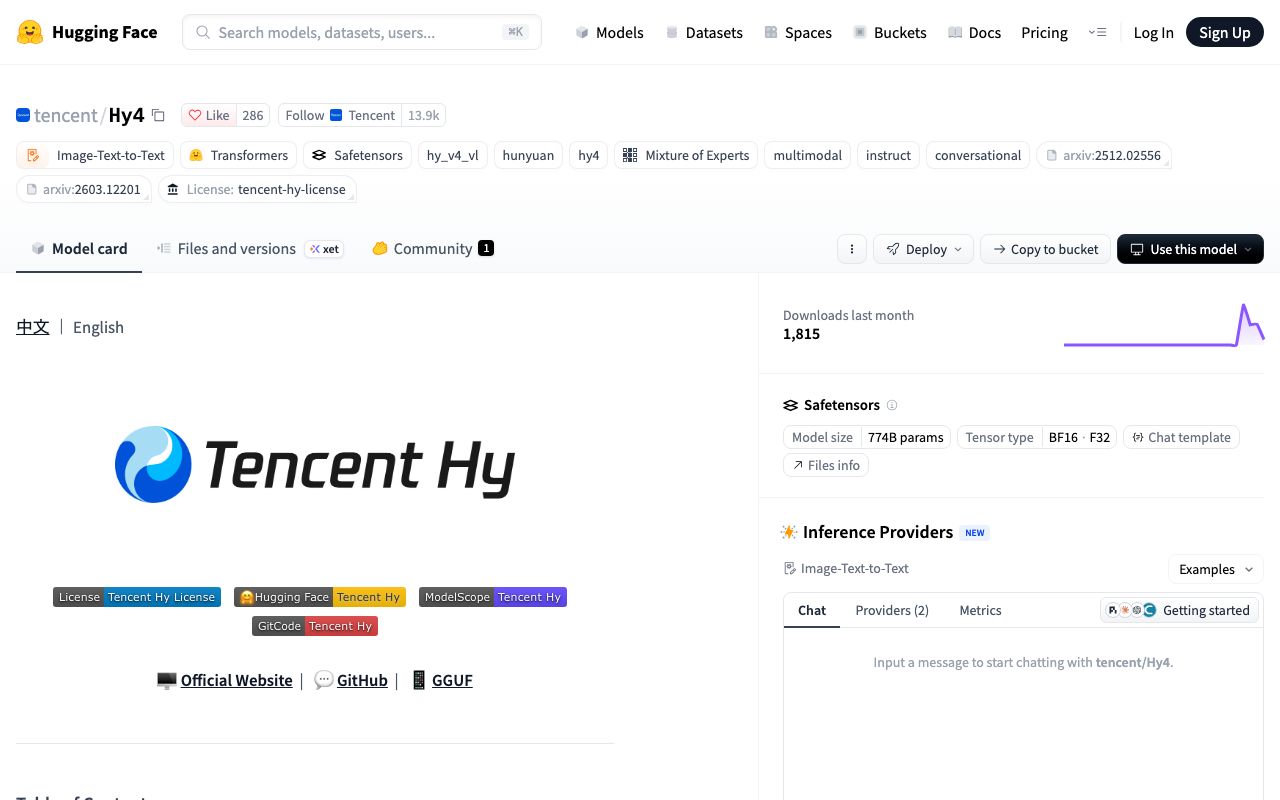
The following three sets of weights were released on Hugging Face, ModelScope and GitCode. All three Hugging Face pages were updated around noon on November 20, Japan time.
- Hy4: tuned to follow instructions, for chat and similar uses
- Hy4-FP8: a version with lighter data that is easier to run with less memory
- Hy4 base: the "raw" model before tuning, for developers who want to train it further for their own use
Tencent also published instructions for further training and for running it with serving software such as vLLM and SGLang.
Same scale as the preview, now with image and video support
According to the model card (the model's documentation), the full version of Hy4 has the following scale.
- Total parameters: about 770 billion (excluding components such as the part that reads images)
- Active per token: about 49 billion in the text part, and about 1.23 billion in the image part
- Amount it can handle at once (context): 1 million tokens
- Input: text, images and video. Output is text
Hy4 is a model built on MoE (mixture of experts), an architecture that activates only some of many "expert" components. The Hy4 preview, whose weights were released in August, also had about 770 billion total parameters, about 49 billion active and a 1M-token context, with the same structure of 78 layers (77 layers excluding the first, each with 256 experts) selecting 8 experts. What differs in the full version is a large increase in pre-training and subsequent tuning, and the addition of an image component with about 1.23 billion parameters so it can read images and video. The preview was a text-only model.
A new auxiliary component for producing text faster (DFly2, about 3.3 billion parameters) has also been built in. The preview used an auxiliary component based on a different mechanism.
The license changes from Apache 2.0 to Tencent's own
Some reports said the model was "released under Apache 2.0," but the license text on Hugging Face and GitHub is the "Tencent Hy License 1.0." It differs from the preview's Apache 2.0. It is the same as the license for Hy4 flash: based on Apache 2.0, with added conditions for large-scale API businesses.
- Commercial use, modification and redistribution are generally permitted
- If you run a business that lets other companies use the model through an API or similar (MaaS), you need a separate agreement with Tencent when your annual revenue (company-wide) exceeds $50 million or when you use it in a service with more than 100 million monthly users
- Products that use the model only within a specific feature do not count as MaaS
- Internal-only use, where neither the model nor its output is made available externally, is not subject to these conditions
The clause in the earlier Hunyuan license that excluded the EU, the UK and South Korea from permitted regions does not appear in this license text. It can be used from Japan under the same conditions as other regions.
Hardware needed to run it
The official instructions describe a setup that runs the FP8 version split across 8 GPUs. It is not a size that can easily be run on a personal computer. For testing, a further compressed version in GGUF format has also been published on the page for Tencent's compression tool.
The model card says performance has improved over the preview, while acknowledging that the gap with top closed models is still large in areas such as research-level math, long-running programming and advanced visual question answering.
CoAI's take
Major Chinese AI companies such as DeepSeek, Kimi and GLM have continued the trend of releasing weights even for their large models. Hy4 broadens the options by releasing the weights of a 770-billion-parameter-class model that can handle both images and video. There are no regional restrictions, and unless you run a large-scale API business, the terms are close to Apache 2.0.
However, it is important to note that, compared with the preview, conditions for large businesses have been added. The performance figures are Tencent's own evaluations and have yet to be verified externally. The safety documentation (system card) is linked from the official site, but the editorial team could not open it from our environment. If you use it for work, check the license text and how data is handled.